
A retirement portfolio can look healthy on paper and still leave an investor with an uncomfortable question each month: where will the cash flow come from? Selling appreciated assets to fund living expenses can be inefficient during market declines. For accredited investors, retirement investments with monthly income can offer a more deliberate approach – pairing portfolio income with an underwriting process designed to protect principal.
The objective is not simply to find the highest stated yield. Durable retirement income depends on the quality of the borrower or issuer, the structure of the investment, the liquidity terms, and whether the income source can withstand ordinary economic stress. A monthly distribution is useful only if the investment supporting it has been evaluated with the same discipline applied to the distribution itself.
What Monthly Retirement Income Is Designed to Solve
Retirement spending is rarely annual. Housing, insurance, healthcare, travel, and family obligations arrive throughout the year. Yet many traditional investments pay on different schedules. Treasury securities and many bonds commonly pay interest semiannually, while dividend schedules can vary and dividend amounts may change.
Monthly income strategies seek to better align investment cash flow with recurring expenses. That alignment may reduce the need to sell liquid securities at an unfavorable time, especially when public markets are volatile. It can also make portfolio cash management clearer for an investor, family office, or advisor overseeing distributions from multiple accounts.
Still, payment frequency should not become the sole selection criterion. A monthly-paying investment with weak credit quality, excessive leverage, or limited collateral can create more risk than a quarterly or semiannual investment with stronger protections. The appropriate question is: what is producing the income, and what stands behind it if conditions change?
Retirement Investments With Monthly Income: Core Choices
A well-constructed income allocation can use more than one source. Each category carries a different mix of yield potential, market sensitivity, liquidity, and principal risk.
Cash equivalents and certificates of deposit
High-yield savings accounts, money market funds, and certificates of deposit can provide accessible income and principal stability within applicable FDIC insurance limits. They are useful for near-term spending reserves. Their limitation is reinvestment risk: when rates decline, income from maturing balances may reset lower.
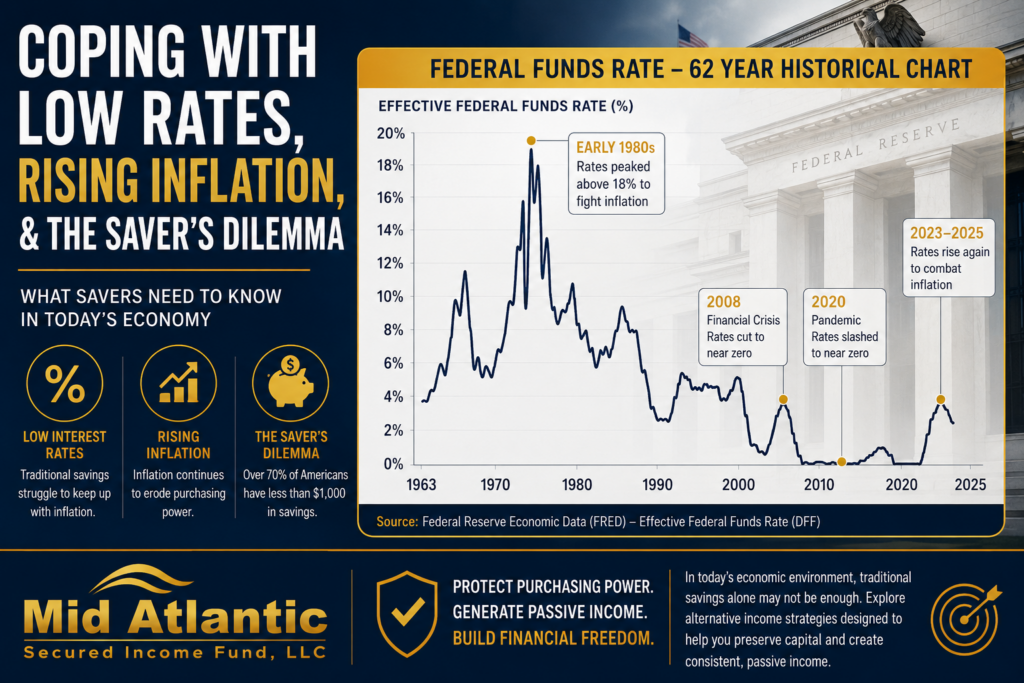
These instruments also may not generate enough income to meet long-term retirement needs after taxes and inflation. The Federal Reserve’s rate policy has a direct effect on available yields, which means cash returns can change materially over a retirement horizon.
Public bonds and bond funds
Investment-grade bonds have long been a foundation of retirement portfolios because they provide contractual interest payments and generally rank ahead of equity in an issuer’s capital structure. Individual bonds may offer known maturity dates, while bond funds provide diversification and professional management.
The trade-off is interest-rate sensitivity. Bond prices can decline when market rates rise, and credit spreads can widen when economic conditions weaken. A fund also does not have the defined maturity experience of a single bond held to maturity. For investors who need predictable monthly cash flow, distribution policies and underlying duration deserve close attention.
Dividend-oriented public equities
Dividend-paying stocks can provide current income and potential long-term growth. They may help a portfolio address inflation better than fixed coupon investments, since successful companies can increase dividends over time.
However, dividends are not contractual obligations. Boards may reduce or suspend them, and share prices can move sharply even when dividend payments continue. Equity income can be appropriate within a diversified retirement plan, but it should not be mistaken for a low-volatility substitute for contractual interest.
Real estate-backed private credit
Private credit secured by real estate can provide an alternative source of current income for eligible accredited investors. Rather than owning a property and relying on rent growth or future appreciation, the investor participates in loans made to borrowers. Interest payments are supported by the borrower’s obligations and, in a properly structured loan, a first-position lien on identified real estate collateral.
This distinction matters. Equity real estate investing places the investor behind operating costs, leasing outcomes, changing property values, and sale timing. Senior secured lending begins with a different priority: repayment of principal and interest. Conservative loan-to-value ratios, independent valuation review, borrower diligence, and documented collateral rights are central to managing that risk.
Private credit is not risk-free, and it is generally less liquid than publicly traded securities. Loans can experience delays, defaults, extensions, and workout requirements. But for investors able to accept private-market liquidity terms, a diversified pool of short-duration, asset-backed loans may offer a meaningful complement to traditional fixed income.
The Underwriting Matters More Than the Headline Yield
A stated distribution rate is only one data point. In private real estate credit, the durability of income begins with loan origination. Investors should understand whether the manager originates and services loans directly, or merely purchases exposure created by others. Direct underwriting can provide greater visibility into borrower quality, collateral, project budget, repayment plan, and servicing decisions.
Loan-to-value is particularly important. If a loan is originated at 65% to 75% of a conservatively supported collateral value, there may be more protection against a decline in property value than in a highly leveraged structure. That cushion does not eliminate loss risk. It does, however, provide a practical margin of safety that a lender can rely upon if a borrower fails to perform.
Other questions deserve equally careful review: Is the lien in first position? What type of property secures the loan? How experienced is the borrower? Is there verified equity in the transaction? What is the intended exit, and does that exit depend on a sale, refinance, or construction completion? How are defaults, extensions, and foreclosures handled?
A disciplined manager should be able to discuss these considerations plainly. Strong outcomes are usually produced by underwriting standards and servicing capability, not by aggressive projections.
Matching Income Investments to Retirement Account Structure
For accredited investors with a former employer plan, an IRA rollover can create more control over investment selection. A self-directed IRA may permit eligible alternative investments, including certain private credit offerings, while preserving the retirement-account framework. The mechanics are more involved than purchasing a publicly traded fund through a brokerage account, so account administration and transaction compliance require attention.
A self-directed IRA investor must avoid prohibited transactions and disqualified-person issues under Internal Revenue Service rules. For example, using IRA capital for a transaction that personally benefits the account holder or certain related parties can create serious tax consequences. Investors should consult qualified tax and legal professionals before directing retirement assets into a private placement.
The investment’s liquidity terms should also fit the account’s future needs. Investors approaching required minimum distributions should consider whether expected distributions, cash reserves, and redemption provisions can support those obligations. A long-duration or illiquid position may be unsuitable if the account will need substantial cash on a fixed schedule.
A Practical Due-Diligence Framework
Before allocating capital, evaluate the income strategy as a lender would. Review the offering documents, fee structure, distribution policy, liquidity provisions, historical performance, and risk disclosures. Ask whether distributions are expected to come from operating interest income rather than new investor capital or asset sales.
Assess diversification as well. A fund with exposure across multiple borrowers, properties, loan maturities, and loan purposes may reduce the impact of a single adverse outcome. Concentration can be appropriate in some circumstances, but it should be understood rather than overlooked.
Finally, distinguish between a target return and a guaranteed result. Private investments can carry loss of principal, and prior distributions do not assure future distributions. A credible income strategy presents both its objectives and its limitations without treating either as an afterthought.
Building a More Intentional Income Allocation
The strongest retirement income plans generally do not rely on one yield source. Cash reserves can cover near-term needs, liquid bonds can provide market-based income and flexibility, and carefully selected private credit can potentially add higher current income backed by tangible collateral. The right allocation depends on liquidity needs, tax status, time horizon, risk capacity, and the investor’s broader holdings.
For investors evaluating real estate-backed lending, the central standard is straightforward: prioritize the quality of the collateral, the seniority of the loan, and the discipline of the underwriting before focusing on the rate. Mid Atlantic Secured Income Fund applies this capital-preservation-first perspective to short-term, first-position real estate lending for accredited investors seeking passive income alternatives.
Monthly income can bring useful structure to retirement cash flow. The more valuable outcome, however, is confidence that every distribution is supported by an investment process built to manage risk when conditions are less favorable.