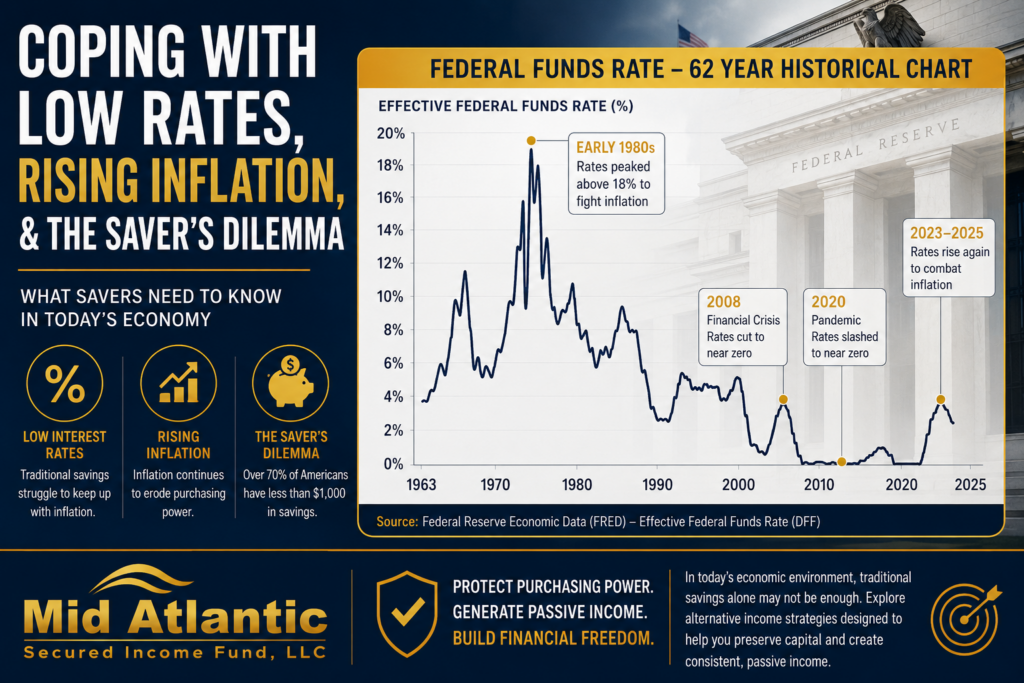

A retiree receiving the same monthly interest payment in 2026 as in 2021 has not necessarily preserved the same spending power. Inflation changes the practical value of income, often quietly: healthcare, insurance, labor, materials, and everyday services can rise faster than a portfolio’s cash flow. That is why accredited investors evaluating inflation resistant investments should look beyond stated yield and consider whether an investment’s structure can adapt to changing prices while protecting principal.
No asset is fully immune to inflation. The more useful question is whether an investment can provide current income, limit the damage from rising rates and declining purchasing power, and avoid placing too much capital at risk in a single economic outcome. For investors who prioritize dependable distributions and capital preservation, that framework can lead to a more disciplined allocation decision.
What Makes an Investment More Inflation Resistant?
Inflation resistance is not a label that an investment earns permanently. It is a set of characteristics that may help an asset retain value or generate income as prices rise. Those characteristics vary by investment type, economic cycle, interest-rate environment, and holding period.
An investment may be better positioned when it has income that can reset over time, a relatively short duration, collateral with tangible value, or cash flows connected to economic activity that can reprice. Conversely, a long-term fixed payment can become less attractive when inflation rises because future dollars purchase less than current dollars.
The Federal Reserve’s policy response also matters. When inflation accelerates, interest rates often rise as policymakers attempt to bring price pressures under control. That can pressure the market value of longer-duration bonds and other fixed-income instruments with below-market coupons. It can also create opportunities for newly originated credit to be priced at current rates.
For income-focused investors, the objective is not to predict every rate move. It is to build a portfolio where income sources, durations, and underlying collateral are thoughtfully diversified.
The Limits of Traditional Fixed Income During Inflation
Conventional bonds can serve important roles in liquidity management and portfolio construction. Yet their relationship with inflation deserves close attention. A bond with a fixed coupon does not automatically increase its income when consumer prices rise. If prevailing yields move higher, its existing coupon may be less competitive, and its market value may decline before maturity.
Duration is central to this risk. In simple terms, duration measures how sensitive a bond’s price may be to changes in interest rates. Longer-duration bonds generally face greater price sensitivity when rates increase. For investors relying on fixed payments to fund retirement spending, that combination of reduced purchasing power and price volatility can be difficult to ignore.
Cash and short-term deposits provide liquidity and stability of nominal principal, but their after-inflation return can be limited when deposit rates trail inflation. Public equities may offer long-run growth potential, but they can be volatile and are not designed to provide predictable income in every market environment. Real estate equity can benefit from higher rents and property values in some settings, but it also carries operational exposure, vacancy risk, development risk, and sensitivity to financing costs.
These trade-offs do not make traditional assets unsuitable. They make allocation decisions more consequential. Investors seeking current income may want exposure to strategies that are designed around shorter lending periods, recurring cash flow, and collateral protection.
Inflation Resistant Investments and Private Credit
Private credit is not inherently inflation-proof. A loan’s performance still depends on borrower quality, underwriting, collateral, documentation, and the broader economic environment. However, certain forms of private credit can offer characteristics that are relevant when inflation and interest rates remain uncertain.
Short-duration, real estate-backed lending is one example. Rather than committing capital to a long-term fixed coupon, a lender may originate loans with relatively brief maturities. As loans repay, capital may be redeployed into new loans at then-current market terms. This can reduce the interest-rate exposure associated with holding a long-duration fixed-income security.
The advantage is not simply a higher stated rate. It is the ability to reassess risk as capital turns over. New underwriting can reflect current property values, construction costs, borrower liquidity, local market conditions, and prevailing rates. That periodic reset is especially valuable in an environment where the cost of capital changes quickly.
For accredited investors, a private fund structure may provide diversified exposure across multiple loans rather than requiring direct participation in a single transaction. This approach can support passive income while leaving loan sourcing, servicing, collateral monitoring, and borrower oversight to an experienced manager.
Why First-Position Collateral Matters
The quality and priority of collateral are fundamental. A first-position mortgage generally gives the lender senior claim on the underlying real estate relative to junior lienholders. If a borrower defaults, lien position can materially affect the lender’s ability to enforce its rights and recover value, subject to the terms of the loan, local law, property conditions, and disposition costs.
Collateral is not a substitute for underwriting. A property can lose value, construction can be delayed, and liquidation can take time. The more conservative approach is to begin with the borrower’s repayment plan, validate the project economics, examine the property, and lend at a disciplined loan-to-value ratio rather than relying on appreciation to solve an underwriting weakness.
Loan-to-value is particularly relevant during inflationary periods. Higher materials and labor costs can strain project budgets. Higher interest rates can reduce buyer demand or refinancing availability. Conservative leverage creates a margin of safety if values soften or a project does not proceed exactly as planned.
The Importance of Loan Duration
A short loan term does not eliminate risk, but it changes the risk profile. In private real estate credit, shorter-duration loans can allow lenders to evaluate repayment and redeployment opportunities more frequently than a long-dated instrument permits.
That flexibility has a trade-off. Loans coming due in a tighter credit market may face refinancing challenges, especially if the borrower’s project has been delayed or the property has not reached stabilization. A disciplined manager must evaluate the borrower’s exit strategy at origination and continue monitoring it through the life of the loan. An expected sale or refinance is not an exit strategy unless there is credible evidence supporting it.
Evaluating Real Estate-Backed Private Credit
Investors should evaluate private credit as a credit strategy first and a real estate strategy second. The question is not whether a property looks attractive. The question is whether the loan can be repaid under reasonable assumptions, with collateral protection if those assumptions prove optimistic.
A thorough review should address the manager’s underwriting standards, target loan-to-value range, lien position, loan duration, borrower experience, servicing capabilities, and approach to defaults and extensions. It should also examine concentration: exposure to a single borrower, project type, geography, or repayment source can create risks that a headline yield does not reveal.
The manager’s alignment matters as well. Investors should understand how loans are sourced, who performs due diligence, how valuations are established, whether third-party reports are used when appropriate, and how the fund handles workout situations. Clear reporting and transparent offering documents are essential because private placements do not provide the daily pricing and liquidity of public securities.
At Mid Atlantic Secured Income Fund, the emphasis is on secured lending rather than equity-style real estate speculation. That distinction matters. A capital-preservation-first credit strategy focuses on first-position collateral, disciplined due diligence, and conservative leverage, with the goal of generating current income while managing downside exposure.
Liquidity, Taxes, and Retirement Accounts
Private credit may be a fit for capital that does not need immediate access. Unlike publicly traded securities, private fund interests can have restrictions on transfers, redemption terms, and notice periods. Investors should match the investment’s liquidity profile to their cash-flow needs, reserve requirements, and time horizon.
Tax treatment also requires care. Income from private credit may be taxed differently from qualified dividends or long-term capital gains. Investors considering a self-directed IRA, rollover IRA, or other retirement-account structure should review the offering documents and consult their tax and legal advisors regarding custody, prohibited transactions, unrelated business taxable income where applicable, and account-specific rules.
A self-directed retirement account can broaden access to alternative investments, but it does not reduce the need for due diligence. The same discipline applies: assess the manager, understand the structure, review risks, and avoid committing retirement capital solely because an investment offers a compelling distribution rate.
Building a More Durable Income Allocation
The strongest case for inflation resistance is rarely found in one asset class. It comes from designing income exposure around several realities: inflation can persist, rates can change, liquidity has value, and principal protection deserves the same attention as yield.
For accredited investors, real estate-backed private credit may complement traditional fixed income by providing asset-backed income, shorter-duration lending exposure, and the potential to reprice capital as loans turn over. Its suitability depends on individual liquidity needs, risk tolerance, tax circumstances, and the quality of the lending program.
A prudent allocation begins with a simple standard: seek income that is supported by disciplined underwriting, meaningful collateral, and a credible path to repayment. In an inflationary environment, that standard can be more valuable than any promise of yield.