
Most retirees do not realize how exposed they are to the same two risks until income becomes the priority – market volatility and reinvestment risk. That is why interest in alternative investments for retirement has grown among accredited investors, particularly those looking beyond a traditional mix of stocks, bonds, and cash equivalents. The real question is not whether alternatives belong in a retirement strategy. It is which alternatives are built for income, risk control, and capital preservation rather than speculation.
Why alternative investments for retirement are getting more attention
For years, many retirement portfolios relied on a familiar formula: public equities for growth, bonds for income, and cash for liquidity. That framework still has a role, but it has become less reliable for investors who need steady distributions and lower portfolio turbulence. Public markets can reprice quickly, and conventional fixed income can leave investors exposed to duration risk, inflation pressure, and yields that do not always compensate for uncertainty.
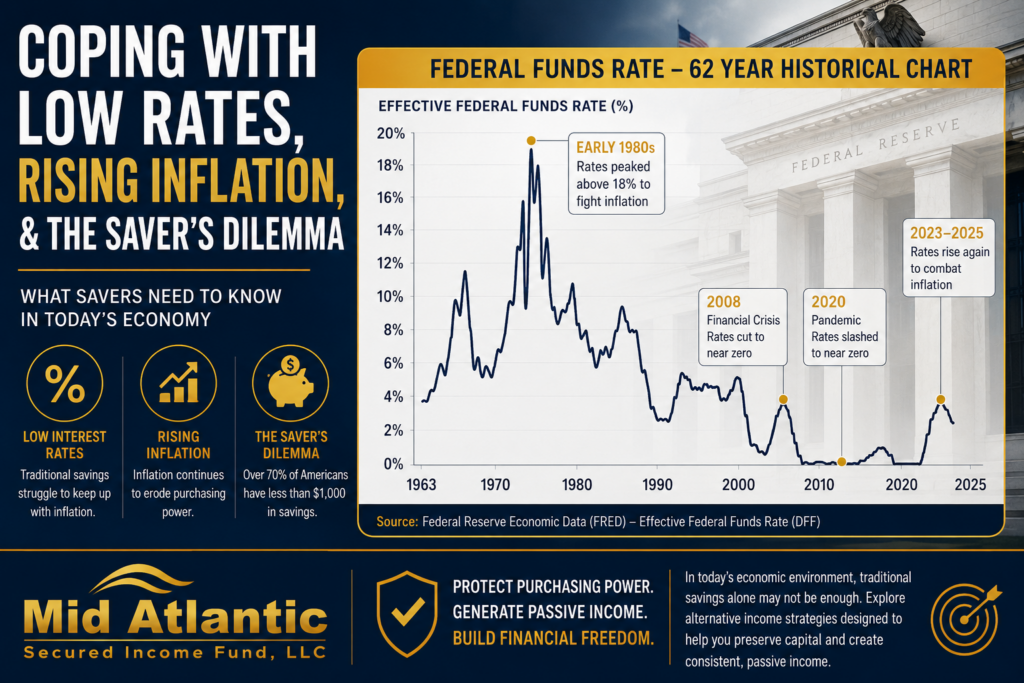
Recent Federal Reserve policy cycles have made that trade-off more visible. When rates rise, bond prices can fall. When rates fall, investors often face reinvestment at lower yields. At the same time, inflation can erode purchasing power even if nominal income appears stable. For retirees and rollover IRA investors, that combination creates a practical problem: a portfolio may look diversified on paper while still depending heavily on public market behavior.
This is where alternatives can serve a real purpose. Not all alternative assets are designed the same way. Some are highly speculative, illiquid, or dependent on appreciation. Others are structured around contractual income, secured positions in the capital stack, and shorter investment duration. For retirement-oriented investors, that distinction matters more than the label itself.
What counts as an alternative investment in a retirement portfolio
In broad terms, alternative investments are assets outside traditional publicly traded stocks, bonds, and mutual funds. That category can include private equity, hedge strategies, direct real estate, commodities, and private credit. For retirement investors, the more useful lens is not asset class branding but investment characteristics.
A retirement-focused alternative should be evaluated on four factors: income reliability, downside protection, correlation to public markets, and operational complexity. Direct rental property, for example, may offer cash flow and inflation sensitivity, but it can also introduce tenant risk, maintenance costs, and execution burden. Equity-style real estate investments may provide upside, but they often depend on appreciation and timing.
By contrast, private credit secured by real estate collateral may appeal to investors who prioritize current income and a more defensive position. In a first-position mortgage structure, the lender typically sits ahead of equity in the capital stack and relies on contractual payments rather than property appreciation alone. That does not eliminate risk, but it changes the nature of the risk.
The difference between chasing yield and building retirement income
A common mistake in retirement allocation is treating every higher-yielding opportunity as interchangeable. Yield by itself says very little about durability. A retirement investor should want to know what generates the income, what secures the position, how long capital is committed, and what underwriting standards stand behind the strategy.
That is especially relevant in private markets. Two investments can advertise similar target yields while carrying very different levels of underlying risk. One may depend on leverage, aggressive assumptions, or thin collateral coverage. Another may be supported by hard assets, conservative loan-to-value ratios, and short-duration lending where principal protection is central to the underwriting process.
For investors evaluating alternatives for retirement accounts, including self-directed IRAs and rollover IRAs, the quality of the income stream matters as much as the level of income. Monthly or periodic distributions supported by borrower payments and collateral can fit retirement objectives more naturally than strategies dependent on future exits or valuation marks.
Why real estate-backed private credit stands out
Among alternative income strategies, real estate-backed private credit deserves serious attention because it combines several features retirees often seek at the same time: current income, asset backing, and lower dependence on public market sentiment.
In this structure, investor capital is typically deployed into short-term loans secured by residential or commercial real estate. These loans may fund construction, redevelopment, bridge needs, or other transitional financing where borrowers value speed and certainty. For investors, the key point is that returns are generally linked to interest payments on loans rather than equity appreciation in the underlying property.
That distinction can improve portfolio behavior in a retirement context. Income from private lending is contractual. The lender also benefits from a defined legal claim against the collateral. When underwriting is disciplined and loan-to-value ratios remain conservative, the collateral coverage can provide an important risk buffer.
There are still trade-offs. Private credit is less liquid than publicly traded securities. Investors should expect holding periods, offering documents, and accreditation requirements. Manager selection is also critical. A secured lending strategy is only as disciplined as its origination, servicing, and workout capabilities. Investors should examine track record, default management, borrower selection, geographic concentration, and how the manager handled difficult periods.
What to look for in alternative investments for retirement
Not every alternative investment deserves a place in a retirement portfolio. Accredited investors should assess structure before headline returns. The strongest opportunities usually show discipline in areas that are easy to overlook during favorable markets.
Start with the source of return. If the return depends mostly on market timing or asset appreciation, it may behave more like a growth allocation than an income allocation. If the return comes from interest payments, backed by collateral and legal documentation, it may be better aligned with retirement cash flow needs.
Next, examine downside protection. In secured private credit, that means understanding lien position, collateral type, loan-to-value policy, borrower equity, and how the manager monitors the asset through the life of the loan. First-position lending with moderate leverage is fundamentally different from subordinated or unsecured exposure.
Duration also matters. Shorter-duration loans can reduce sensitivity to long-term rate movements and allow capital to recycle more frequently as market conditions change. For investors concerned about locking into a long-term rate environment, that flexibility can be valuable.
Finally, pay close attention to manager behavior, not just manager marketing. Conservative firms tend to speak clearly about risks, underwriting standards, reserves, and portfolio monitoring. They do not frame private investing as a shortcut to outsized returns. They frame it as a structured approach to balancing income and risk.
Where alternatives fit alongside traditional assets
Alternative investments should not be viewed as a replacement for every traditional holding. They are generally most effective as a complement to public market exposure, particularly for investors who need more diversification in their income sources. A retiree who relies entirely on stock dividends and bond coupons may benefit from adding private income streams that are driven by borrower payments and collateralized lending activity instead of daily market pricing.
The right allocation depends on liquidity needs, time horizon, tax considerations, and the investor’s overall net worth. An investor drawing current income may prioritize predictable distributions. Another may use alternatives inside a self-directed IRA to diversify dormant retirement capital from an old 401(k) rollover. In both cases, suitability depends on the broader portfolio and the investor’s tolerance for reduced liquidity.
This is also why alternatives work best when expectations are realistic. They are not a cure for every retirement planning challenge. They can, however, help address a specific gap: the need for income-producing assets that do not move in lockstep with stocks and long-duration bonds.
A disciplined standard matters more than a broad category
The phrase alternative investments covers too much ground to be useful on its own. For retirement investors, the more meaningful question is whether a strategy is speculative or disciplined, equity-like or income-oriented, loosely structured or backed by collateral and underwriting controls.
That is where a capital-preservation-first mindset becomes valuable. In private real estate credit, conservative loan sizing, first-position security, asset-level due diligence, and active servicing are not minor details. They are the foundation of the investment case. Firms such as Mid Atlantic Secured Income Fund have built their positioning around that principle because retirement capital generally benefits more from consistency and protection than from aggressive risk-taking.
For accredited investors seeking passive income beyond conventional fixed income, the strongest alternatives are often the least flashy. They are designed to produce cash flow, protect principal through structure, and reduce dependence on public market swings. That may not satisfy investors looking for excitement. For retirement capital, that is often the point.
A useful next step is to evaluate each opportunity by asking a simple question: if markets become less forgiving, what is supporting the income and protecting the downside?