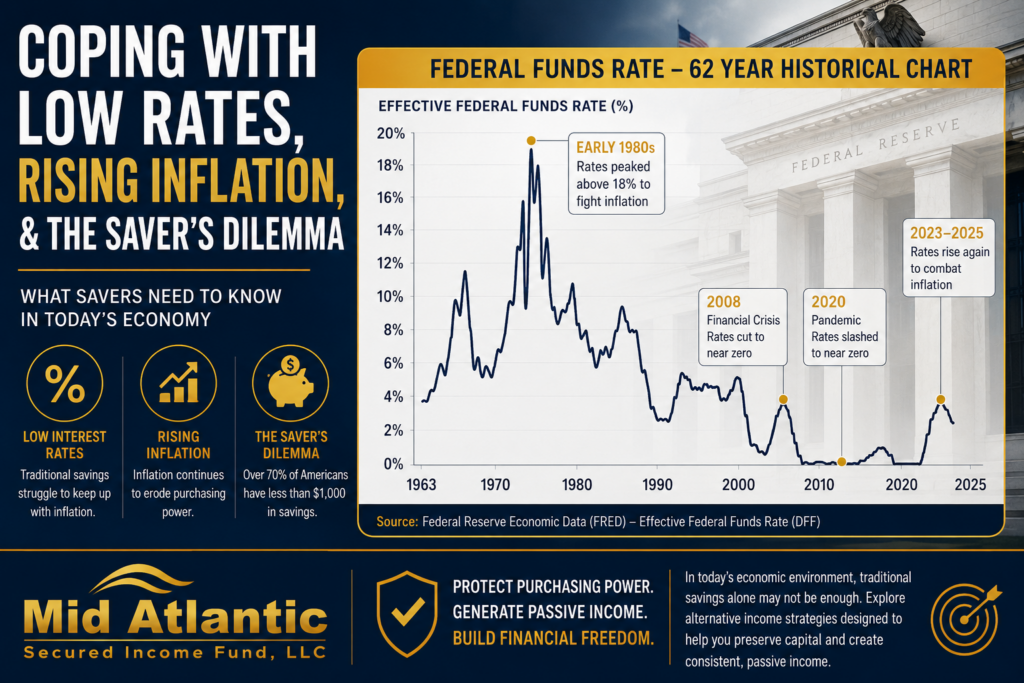

Inflation can change the meaning of income. A stated distribution or interest payment may remain consistent while the purchasing power of those dollars declines. For accredited investors evaluating private credit during inflation, the central question is not whether private credit is automatically an inflation hedge. It is whether the lender’s underwriting, collateral position, loan structure, and portfolio discipline are suited to the conditions at hand.
Private credit is not a single asset class with a uniform response to rising prices or changing interest rates. Outcomes can differ materially by borrower type, collateral, duration, rate structure, leverage, expenses, servicing practices, and the manager’s ability to address problems when they arise. A disciplined review begins with those variables rather than a headline about yield.
Why Inflation Changes the Credit Conversation
Inflation affects both sides of a lending relationship. Borrowers may face higher labor, materials, insurance, property-tax, and operating costs. Those expenses can reduce project margins, slow a renovation or redevelopment plan, or make a refinancing event more difficult. At the same time, lenders must consider whether collateral value, borrower liquidity, and the path to repayment remain adequate if costs rise or market conditions weaken.
Interest-rate changes often add another layer. When market rates move higher, the cost of capital can increase and values for some assets can come under pressure. A borrower whose business plan depends on a sale, lease-up, or refinance may encounter a narrower margin for error than anticipated. This does not mean every loan becomes impaired during inflation. It means underwriting assumptions deserve more scrutiny.
For income-oriented investors, inflation also creates a real-return question. Nominal income may be useful, but it should be evaluated against purchasing-power erosion, fees, taxes, and the illiquid nature of many private investments. Private credit can have a role in a diversified allocation, but it is not a substitute for cash reserves or a guarantee against inflation.
Private Credit During Inflation: Start With the Loan Structure
The terms and structure of a loan often matter more than broad labels. A fixed-rate loan provides known contractual income, but its economics may become less attractive to a lender if market rates rise after origination. A floating-rate loan may adjust as reference rates change, subject to its specific documentation, floors, caps, and borrower capacity. Neither structure is inherently superior in every environment.
Duration also matters. Shorter expected loan terms may allow a lender to reassess pricing and underwriting more frequently as loans repay and capital is redeployed. Longer-duration loans can offer different planning benefits, but they may leave less flexibility if financing conditions change. Actual repayment timing can differ from expectations, especially when extensions, modifications, or workout activity become necessary.
Investors should also distinguish contractual interest from realized portfolio results. A loan can be current for a period while its underlying collateral or borrower financial condition deteriorates. Conversely, an experienced lender may take corrective action before a problem becomes severe. The quality of loan administration, covenant monitoring where applicable, documentation, servicing, and escalation procedures is part of the investment analysis.
Senior-Secured Real Estate Lending and Collateral Discipline
For a private real estate credit strategy, collateral quality and lien priority are foundational considerations. Senior-secured, first-position real estate lending generally places the lender ahead of subordinate lienholders in the collateral structure, subject to the governing loan documents and applicable law. That priority can be meaningful in a stressed situation, but it does not eliminate the risk of loss, delay, legal expense, valuation changes, or a collateral disposition below expectations.
A capital-preservation-oriented approach typically focuses on more than an appraised value at closing. Disciplined underwriting may examine the property, borrower experience, sources and uses of capital, project budget, exit assumptions, title and insurance matters, market conditions, and the borrower’s ability to carry the transaction through a slower or more expensive environment.
During inflationary periods, conservative assumptions become especially relevant. Construction and renovation projects may require attention to contingency planning and cost-to-complete risk. Transitional properties may require careful analysis of leasing, operating expenses, and sponsor liquidity. Loans dependent on a future sale or refinancing require a clear view of what could happen if that exit takes longer than planned.
At Mid Atlantic Secured Income Fund, the investor offering is centered on a private credit fund with an emphasis on senior-secured, first-position real estate lending and disciplined underwriting. Eligible accredited investors should review the applicable offering documents carefully to understand the fund’s investment objective, strategy, fees and expenses, conflicts, risks, valuation practices, and liquidity provisions. Safe, Simple, Secured is a positioning framework, not a statement that an investment is safe or free of risk.
Income Potential Must Be Considered Alongside Liquidity
Private credit is commonly evaluated for current-income potential, but income is only one element of total investment decision-making. Unlike publicly traded securities, interests in a private fund may not be readily transferable or redeemable. An investor may need to hold an investment for an extended period and may not be able to access capital when market conditions or personal circumstances change.
That constraint can be particularly important when inflation affects household, business, or family-office cash needs. Investors should avoid committing capital that may be required for near-term obligations. Self-directed IRA and rollover IRA investors should also understand that account rules, custodial processes, prohibited-transaction considerations, and liquidity needs can be complex. Qualified tax, legal, and financial advisers can help investors assess issues specific to their circumstances.
Transparency supports better decision-making, but reporting is not a replacement for due diligence. Investors may wish to understand how a manager communicates portfolio developments, valuations, nonperforming assets, extensions, modifications, realized losses, concentration, and material conflicts. The right questions are often as useful as the answers: What is being measured? How frequently is it reported? What assumptions underlie the valuation? What happens when a loan does not repay on its original schedule?
What to Review Before Allocating Capital
A thoughtful private-credit review should connect the fund’s stated strategy to the actual risks an investor is taking. Review the governing documents, including risk factors and fee disclosures, rather than relying solely on marketing materials. Consider the manager’s underwriting process, collateral standards, servicing capabilities, portfolio-construction approach, use of leverage if any, valuation methodology, and policies for extensions or workouts.
It is also prudent to consider concentration. A portfolio can be affected by exposure to particular property types, borrowers, geographies, loan maturities, or economic assumptions. Diversification within a fund may reduce exposure to a single loan, but it does not eliminate market, credit, interest-rate, liquidity, operational, or valuation risk.
Past performance, if presented in approved materials, does not guarantee future results. Targets and projections are not assurances of future income or principal preservation. Investors should assess whether an allocation fits their objectives, risk tolerance, time horizon, and need for liquidity.
A Separate Path for Qualified Borrowers
The fund’s investor strategy should not be confused with the broader financing products available through Mid Atlantic Secured Income Fund’s alternative lending platform. Qualified borrowers may seek business-purpose financing for commercial bridge transactions, acquisitions, construction, renovation and redevelopment, site and land development, lot acquisition, fix-and-flip projects, medical receivables, purchase orders, inventory, commercial automotive needs, litigation finance, or working capital.
Each borrower request is evaluated on its own facts, documentation, collateral or receivable quality where relevant, repayment source, and underwriting considerations. Eligibility, availability, and terms vary. Importantly, the availability of a financing product through the lending platform does not mean that product is held by, collateralizes, or generates returns for the investment fund.
Inflation is a useful reminder that credit investing rewards specificity. Rather than asking whether private credit will outperform in a particular macroeconomic environment, investors are better served by examining the protections, assumptions, limitations, and decision-makers behind each strategy before committing capital.