
A retiree rolling over an old 401(k) is often told to choose between low-yield cash products and market-based portfolios that can swing hard at the wrong time. That is exactly where alternative lending solutions start to matter. For accredited investors focused on income, principal protection, and lower correlation to public markets, private credit backed by real assets can fill a gap that traditional fixed income no longer covers well.
The phrase gets used broadly, so it helps to narrow the field. In practice, alternative lending solutions include private loans made outside conventional banks and public bond markets. Some are unsecured and highly cyclical. Others are collateralized, short duration, and underwritten with a strong bias toward downside protection. Those differences are not minor. They are the whole story.
What alternative lending solutions actually include
At the broadest level, alternative lending refers to financing provided by non-bank lenders. That can range from merchant cash advances to private corporate credit to real estate bridge lending. For investors, these categories should not be treated as interchangeable. A loan secured by a first-position mortgage on income-producing or value-add real estate has a very different risk profile than unsecured consumer credit or venture-style lending.
For borrowers, alternative lending solutions are often attractive because they move faster than banks and can accommodate situations banks may avoid. A developer with a renovation timeline, an investor buying a property that needs stabilization, or a business bridging a short-term receivables gap may need execution speed and loan structures that fit the project rather than a rigid bank checklist.
For investors, the appeal is usually different. The goal is not speed. It is income with discipline. That means asking what stands behind the loan, where the lender sits in the capital stack, how conservative the loan-to-value ratio is, and whether the duration matches the need for liquidity and rate sensitivity.
Why accredited investors are looking beyond traditional fixed income
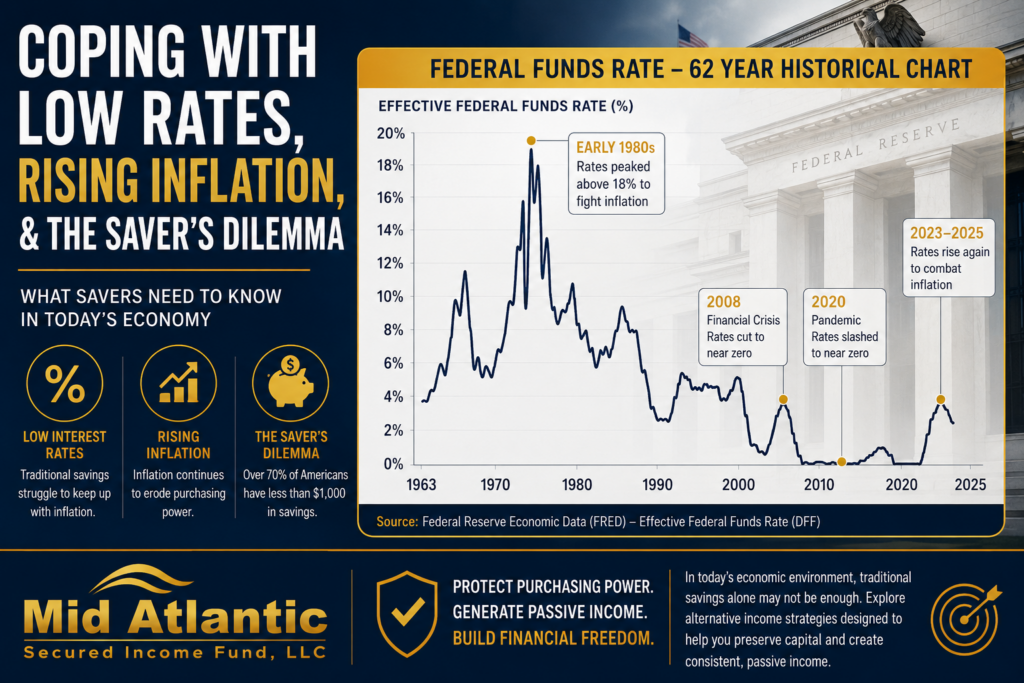
The search for dependable income has become more complex. The Federal Reserve’s rate cycles can improve yields on cash for a period, but inflation and reinvestment risk remain real concerns. Public bonds can also lose value when rates rise, particularly when duration is longer. Equities may provide growth over time, but they are not designed to deliver predictable monthly income with low volatility.
That backdrop has pushed many accredited investors to consider private credit as a complement to stocks and bonds. The attraction is not novelty. It is structure. A carefully underwritten private loan portfolio can offer current income tied to contractual borrower payments, with risk mitigation supported by collateral, covenants, and active servicing.
This is especially relevant for self-directed IRA investors and those evaluating rollover IRA strategies. When retirement assets are no longer in active employer plans, investors often begin to prioritize cash flow and capital preservation more explicitly. They may still want growth exposure elsewhere, but they are also looking for investments that can work harder than idle cash without taking on equity-like volatility.
The strongest alternative lending solutions are built on collateral
Not all yield is created the same way. In private credit, investors should separate yield generated by credit discipline from yield generated by taking hidden risk. A higher stated return means less if the underlying asset quality, lien position, or underwriting process is weak.
Real estate-backed private credit tends to stand out because the collateral is tangible, appraisable, and legally secured. When a lender originates short-term first-position mortgage loans at conservative loan-to-value ratios, the investment thesis becomes easier to evaluate. The lender is not relying solely on borrower optimism or future market expansion. It is relying on collateral coverage, borrower equity, and a clearly defined exit strategy.
That does not eliminate risk. Real estate values can change. Construction timelines can slip. Borrowers can face liquidity stress. But first-position security and disciplined leverage limits can improve recovery prospects in a way unsecured lending cannot. For investors who care first about avoiding permanent capital impairment, that distinction matters.
How to evaluate alternative lending solutions with discipline
A sophisticated investor should approach private lending the way an institutional credit committee would. Start with underwriting standards. Conservative lenders typically focus on asset value, borrower experience, project feasibility, debt service considerations where applicable, and realistic exit assumptions. If a manager cannot explain its underwriting process in concrete terms, that is a warning sign.
The next issue is lien position. First-position loans generally offer stronger control rights and recovery potential than subordinate debt. From there, look at loan-to-value ratios. A portfolio consistently originated around 65 to 75 percent loan-to-value usually reflects a more conservative stance than one pushing leverage to the edge.
Duration also deserves close attention. Shorter-duration loans can reduce exposure to interest rate changes and allow capital to recycle more frequently. In uncertain rate environments, that flexibility can be useful. At the same time, shorter duration creates reinvestment considerations, so portfolio management still matters.
Servicing and asset management are often overlooked by newer investors in the space. Origination is only one part of risk control. Ongoing borrower communication, draw management for construction loans, payment tracking, and proactive workout capability all affect outcomes. A private credit strategy is only as strong as its operational discipline.
Alternative lending solutions for borrowers and why that matters to investors
The quality of an investment manager’s borrower base affects portfolio stability. Borrowers do not seek private credit for one reason only. Some need a bridge loan to move quickly on a time-sensitive acquisition. Some are renovating or redeveloping a property that does not qualify for bank financing in its current condition. Others need construction financing with staged draws and close oversight. Some operating businesses may need receivables or invoice factoring to smooth short-term working capital timing.
These can be legitimate, financeable use cases when structured correctly. What matters is whether the lender is solving a temporary, identifiable capital need with a clear repayment path. That is very different from lending into distress without a credible exit.
Investors should prefer managers who understand both borrower need and collateral protection. The best alternative lending solutions are not simply fast money. They are structured capital solutions with underwriting guardrails. When that balance is missing, speed becomes a liability instead of an advantage.
Where private real estate credit fits in a portfolio
For many accredited investors, private real estate-backed lending is not a replacement for every other asset class. It is a portfolio role player with a specific job. That job is often to provide current income, lower volatility than public equities, and a degree of inflation resilience through shorter loan terms and secured asset exposure.
It may fit particularly well in capital earmarked for passive income, retirement distributions, or diversification away from public market sentiment. That includes self-directed IRAs and rollover accounts where investors want exposure to private markets without the operational burden of directly owning and managing real estate.
The trade-off is liquidity. Private credit funds and direct lending programs are typically less liquid than public securities. Transparency can also vary by manager, which makes due diligence essential. Investors should understand distribution policy, redemption terms if any, fee structure, portfolio concentration, and historical credit performance. A disciplined strategy can be compelling, but private always means manager selection matters.
What separates durable lenders from opportunistic ones
The market does not reward caution every quarter, but over a full credit cycle it often does. Durable lenders tend to share a few characteristics. They emphasize capital preservation before yield maximization. They lend against collateral they understand. They maintain conservative leverage and avoid stretching into thinly protected structures just to post a higher number.
They also talk clearly about risk. If a lender presents private credit as simple or fails to discuss defaults, workouts, and market slowdowns, that should raise questions. Experienced operators understand that successful lending is not about pretending risk is absent. It is about structuring around risk, pricing it appropriately, and managing it consistently.
That is why many sophisticated investors gravitate toward managers with a defined niche, repeatable underwriting process, and proven servicing infrastructure. In real estate-backed private credit, consistency usually comes from saying no often, not from approving every deal that crosses the desk.
Alternative lending solutions can be highly effective when they are asset-backed, conservatively underwritten, and managed with discipline. For accredited investors seeking high current income with a stronger emphasis on collateral and downside protection, that combination deserves serious attention. The right question is not whether an investment is alternative. It is whether the structure, collateral, and underwriting support the outcome you actually need.