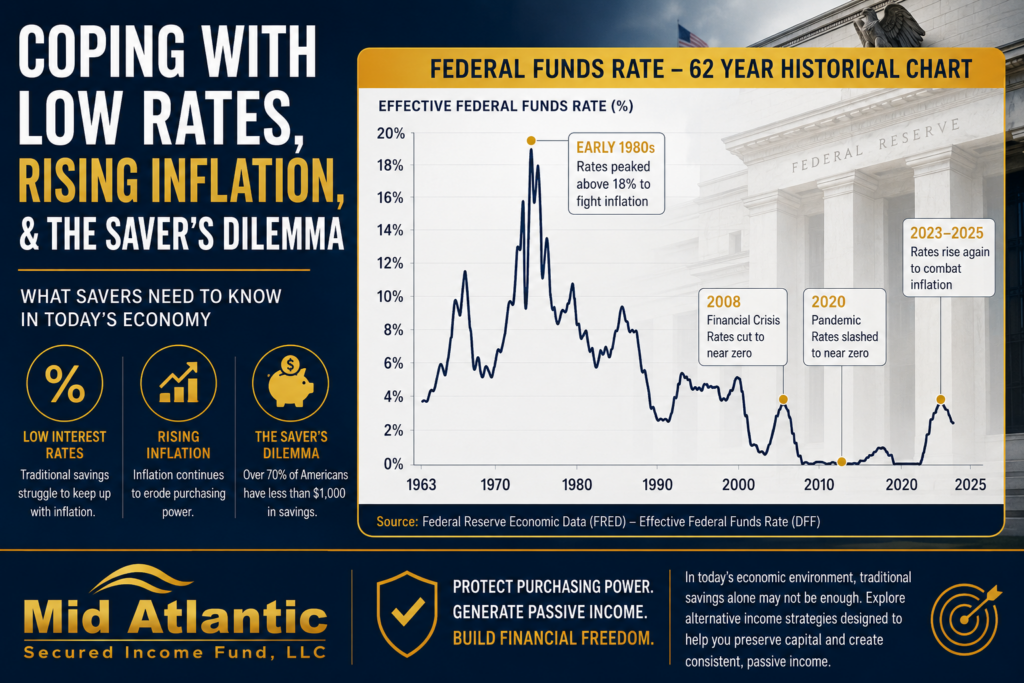

Retirement income planning becomes more demanding when portfolio withdrawals begin. Public-market income can fluctuate, cash may not keep pace with long-term spending needs, and a concentrated allocation can create avoidable pressure at the wrong time. This guide to real estate backed retirement income explains how eligible accredited investors may evaluate private real estate credit as one component of a broader income strategy – with capital preservation, collateral quality, liquidity, and underwriting discipline at the center of the decision.
Real estate-backed income is not a replacement for cash reserves, diversified public holdings, or individualized planning. It is a private-market allocation that requires careful review of the sponsor, the offering documents, the underlying lending strategy, fees, risks, and redemption provisions.
What Real Estate-Backed Retirement Income Means
In this context, retirement income is generated by lending capital secured by real estate rather than owning a property directly. A private credit fund may originate or acquire loans and receive interest payments from borrowers. Investors may participate in the fund structure, subject to the governing offering documents, rather than selecting individual properties or managing tenants.
The distinction matters. Direct real estate ownership can involve leasing, maintenance, property taxes, capital expenditures, and sale timing. Senior-secured real estate lending focuses instead on the quality of the loan, the collateral, the borrower’s plan, and the lender’s remedies if that plan does not perform as expected.
A first-position lien generally gives the lender priority in the collateral relative to junior lienholders. That priority can be a meaningful risk-control feature, but it does not eliminate loss risk. Property values can decline, construction can be delayed, costs can rise, borrowers can default, and a foreclosure or workout may be lengthy and expensive. Collateral is a source of potential recovery, not a guarantee of principal repayment.
Why Retirement Investors Consider Private Real Estate Credit
For accredited investors who can accept reduced liquidity, private credit may offer a different source of potential income than publicly traded stocks and bonds. The appeal often begins with a defined lending process: loans are underwritten, documented, secured by specified collateral, monitored, and managed through a stated investment mandate.
This structure can be particularly relevant for investors seeking to understand where risk is being taken. Rather than relying only on market pricing, they can assess a manager’s underwriting standards, seniority in the capital stack, property-level collateral practices, concentration limits, servicing capabilities, and reporting discipline.
That said, private investments carry their own set of trade-offs. Valuations may not update daily. Interests may be difficult to sell quickly. Distributions, if any, can change, and an investor may not be able to redeem capital on a preferred timeline. A retirement allocation should therefore begin with liquidity planning, not with an income objective alone.
A Guide to Real Estate Backed Retirement Income Due Diligence
A disciplined review starts with the fund’s legal and operational framework. Read the private placement memorandum, subscription materials, operating agreement or partnership agreement, and any current investor reporting. These documents govern the investment, including fees, conflicts, liquidity provisions, risk factors, valuation policies, and the manager’s authority.
Start with the lending mandate
Ask what the fund is designed to do. Is it focused on senior-secured, first-position real estate loans? What property types, borrower profiles, loan purposes, and geographic markets may be considered? Is the fund permitted to use leverage, invest in participations, hold nonperforming loans, or retain real estate acquired through a workout?
A clear mandate helps an investor determine whether the strategy fits the intended role in a portfolio. Broad flexibility is not inherently negative, but it warrants a clear explanation of who makes investment decisions and what controls govern exceptions.
Examine underwriting and collateral quality
Underwriting is where capital-preservation objectives become operational. A thoughtful process may include review of the borrower’s experience, project budget, sources and uses, property condition, marketability, title, insurance, exit strategy, and relevant legal documentation.
The central question is not simply whether a borrower expects to repay. It is whether the lender has analyzed reasonable downside scenarios and structured the loan with adequate protections for the risks involved. Investors should understand how collateral is valued, how construction or renovation progress is monitored when applicable, and how underwriting assumptions are challenged before closing.
Understand concentration and servicing
Even a portfolio of secured loans can become exposed to a narrow set of risks. Concentration may arise by borrower, property type, geography, loan purpose, maturity profile, or source of repayment. A manager should be able to explain how it monitors those exposures and how it addresses loans that require additional attention.
Servicing capabilities also matter. Loan administration includes payment tracking, covenant monitoring, insurance oversight, documentation management, borrower communication, and escalation when a loan underperforms. Investors should ask who performs these functions and how potential conflicts are managed.
Treat liquidity as a retirement planning issue
Private fund interests are often illiquid. Redemption rights, if offered, may be limited, subject to notice periods, gates, manager discretion, available cash, or other conditions specified in the offering documents. There may be no secondary market.
For that reason, capital committed to private credit should generally be capital an investor can afford to leave invested for an uncertain period. Investors planning near-term retirement withdrawals, major purchases, or required account distributions should discuss cash-flow needs with qualified tax, legal, and financial advisers before committing capital.
Reporting Is Part of Risk Management
Transparent reporting cannot prevent a credit issue, but it gives investors a better basis for oversight. Useful reporting may address portfolio composition, loan status, repayments, new originations, material workout activity, valuation approach, expenses, and changes that could affect the strategy.
The right level of detail depends on the offering and investor rights. Still, investors should be able to identify what they own, understand the manager’s stated process, and ask informed questions when conditions change. A manager that communicates clearly about both performing loans and challenged situations demonstrates a more disciplined approach than one that relies only on headline income figures.
Mid Atlantic Secured Income Fund positions its investor strategy around senior-secured, first-position real estate lending, disciplined underwriting, collateral quality, and transparent investor reporting. Eligible investors should review current offering materials carefully to determine the actual strategy, risks, fees, liquidity terms, and suitability considerations.
Keep the Investor and Borrower Journeys Separate
A private credit fund’s investment strategy should not be confused with every financing product available through an affiliated or related alternative lending platform. Qualified borrowers may seek business-purpose financing for commercial bridge loans, acquisition and construction projects, renovation or redevelopment, site and land development, lot acquisition, or fix-and-flip projects.
A lending platform may also evaluate non-real-estate business-purpose needs, such as medical receivables financing, purchase-order funding, litigation finance, commercial automotive financing, inventory-backed financing, or working capital tied to purchase orders. Eligibility, documentation, collateral, and terms vary by transaction.
These borrower solutions do not mean every loan is held by, collateralizes, or generates returns for an investment fund. Investors should rely on the applicable offering documents and portfolio reporting to understand the fund’s actual holdings. Borrowers should evaluate financing based on their business purpose, repayment capacity, collateral, and transaction-specific requirements, without assuming that an investor fund is the source of capital.
Questions Worth Asking Before You Commit
Before making an allocation, ask how the manager defines its capital-preservation objectives, what seniority it seeks, how it handles underwriting exceptions, and what occurs when a borrower misses a payment. Ask how fees are charged, whether affiliates receive compensation, how valuations are determined, and what factors could delay a return of capital.
It is also reasonable to ask about reporting cadence, audit and tax-document processes, insurance requirements, servicing responsibilities, and the manager’s experience with workouts. The goal is not to find an investment without risk. The goal is to identify whether the risks are understandable, appropriately compensated in your own planning, and managed through a repeatable process.
Past performance, if presented in approved materials, does not guarantee future results. Private real estate credit can involve loss of principal, illiquidity, borrower default, valuation changes, conflicts of interest, and other material risks. Accredited investor status alone does not establish that an offering is appropriate for any particular investor.
Retirement income planning works best when each allocation has a clear purpose. For investors considering real estate-backed private credit, that purpose should be grounded in documented underwriting, senior-secured collateral where applicable, realistic liquidity expectations, and the patience to conduct full due diligence before capital is committed.