A Strategic Guide for Accredited Investors Exploring Alternative Retirement Investments
Retirement investing is evolving.
For decades, many retirement portfolios were heavily concentrated in publicly traded stocks, mutual funds, and traditional bond allocations. While these investments continue to play an important role in portfolio construction, sophisticated investors are increasingly looking beyond conventional retirement strategies in search of diversification, income generation, inflation resilience, and broader access to alternative investments.
This shift has contributed to the growing popularity of Self-Directed IRAs (SDIRAs).
Unlike traditional retirement accounts that are often limited to public securities, SDIRAs provide eligible investors with access to a significantly wider range of alternative assets, including:
- private credit,
- real estate,
- private lending,
- real estate-backed debt,
- private placements,
- tax liens,
- infrastructure,
- and other non-traditional investments.
As alternative investing expands, choosing the right SDIRA custodian has become one of the most important decisions investors make when building tax-advantaged retirement strategies.
The custodian serves as the administrative and compliance backbone of the retirement account. The right provider can improve operational efficiency, simplify investment execution, and enhance the investor experience. The wrong custodian can create delays, confusion, unnecessary fees, and operational friction.
For accredited investors evaluating alternative income-oriented investments, understanding how SDIRA custodians operate — and how to evaluate them strategically — is increasingly essential.
What Is a SDIRA Custodian?
Direct Answer
A Self-Directed IRA (SDIRA) custodian is a financial institution or trust company responsible for administering self-directed retirement accounts and ensuring IRS compliance for retirement assets held within the account.
SDIRA custodians typically:
- facilitate account setup,
- process transactions,
- maintain IRS reporting,
- hold retirement assets,
- administer investment paperwork,
- and oversee operational compliance requirements.
Unlike traditional brokerage firms, SDIRA custodians generally allow investors to access alternative investments beyond stocks and mutual funds.
Why SDIRAs Are Growing in Popularity
The rise of SDIRAs reflects several major investment trends shaping retirement planning in 2026.
1. Growing Demand for Diversification
Many investors are increasingly concerned about concentration risk in public markets.
The traditional retirement framework centered heavily around equities and bonds may leave portfolios exposed to:
- equity market volatility,
- inflation risk,
- interest rate uncertainty,
- and public market correlation.
SDIRAs allow investors to diversify into alternative assets with different risk and return profiles.
2. Increased Interest in Alternative Investments
According to Preqin and BlackRock research, institutional allocations to alternative investments continue to rise globally.
Individual accredited investors are increasingly seeking similar access through SDIRAs.
Popular SDIRA investment categories include:
- private credit,
- real estate debt,
- private lending,
- multifamily real estate,
- infrastructure,
- and secured income investments.
3. Tax-Advantaged Growth Potential
SDIRAs retain many of the same tax advantages associated with traditional retirement accounts.
Depending on the structure:
- taxes may be deferred,
- or investment growth may potentially occur tax-free in Roth structures.
This creates attractive long-term compounding opportunities for eligible investors.
4. Retirement Income Planning
Many investors nearing retirement increasingly prioritize:
- recurring cash flow,
- inflation resilience,
- portfolio diversification,
- and alternative income sources.
Alternative investments accessed through SDIRAs may complement broader retirement planning strategies.
What Makes Choosing a SDIRA Custodian So Important?
Not all SDIRA custodians operate the same way.
Some focus heavily on:
- real estate transactions,
- others specialize in private placements,
- while some emphasize streamlined digital onboarding and investor education.
The custodian plays a critical operational role in:
- transaction processing,
- document execution,
- compliance management,
- funding timelines,
- and ongoing account administration.
Operational efficiency becomes especially important for alternative investments involving:
- private lending,
- real estate-backed investments,
- and institutional alternative investment structures.
Key Factors to Evaluate When Choosing a SDIRA Custodian
1. Experience With Alternative Investments
Some custodians are significantly more experienced handling:
- private credit,
- real estate debt,
- alternative income funds,
- and institutional private investments.
This experience matters because alternative investments often involve:
- specialized subscription documents,
- funding procedures,
- compliance requirements,
- and more complex administrative workflows.
Investors should evaluate whether the custodian regularly processes:
- private placements,
- real estate transactions,
- secured lending investments,
- and alternative income structures.
2. Transaction Processing Efficiency
Alternative investments frequently involve time-sensitive funding windows.
Delays in:
- document review,
- wire approvals,
- or processing timelines
can negatively impact investment execution.
Sophisticated investors increasingly prioritize custodians with:
- responsive support teams,
- streamlined processing systems,
- digital workflows,
- and operational efficiency.
3. Fee Structure Transparency
SDIRA fee structures vary considerably.
Common fees may include:
- account setup fees,
- annual maintenance fees,
- transaction processing fees,
- wire fees,
- asset holding fees,
- and account termination fees.
Investors should evaluate:
- fee transparency,
- scalability,
- and overall operational value.
The lowest-cost provider is not always the best long-term choice if operational inefficiencies create investment friction.
4. Investor Education & Support
Alternative investing can involve additional complexity versus traditional brokerage accounts.
Strong custodians often provide:
- educational resources,
- dedicated account support,
- onboarding assistance,
- and investment processing guidance.
This can be especially valuable for:
- first-time SDIRA investors,
- retirement-focused investors,
- and individuals transitioning from traditional brokerage retirement accounts.
5. Digital Infrastructure & Technology
Operational technology matters more than many investors realize.
Strong digital infrastructure may improve:
- document management,
- transaction tracking,
- account visibility,
- communication speed,
- and overall investor experience.
Investors increasingly prefer custodians offering:
- online portals,
- digital signatures,
- secure document upload systems,
- and streamlined account management tools.
6. Reputation & Industry Standing
Investors should evaluate:
- industry reputation,
- operational history,
- client reviews,
- and experience handling alternative investments.
Longevity and operational consistency may provide additional confidence when evaluating retirement custodians.
Understanding the Role of Preferred Custodian Networks
Many alternative investment firms work alongside established SDIRA custodians familiar with their operational processes and investment structures.
Preferred custodian relationships can improve:
- onboarding efficiency,
- transaction familiarity,
- document coordination,
- and funding workflows.
At The Mid Atlantic Secured Income Fund, investors frequently work with established SDIRA custodians experienced in handling alternative investments and private credit structures.
The fund’s SDIRA investing resource page highlights several custodial relationships and preferred provider options frequently utilized by retirement investors exploring alternative income-oriented investments.
These providers may help facilitate:
- account establishment,
- SDIRA rollovers,
- alternative investment processing,
- and retirement account administration.
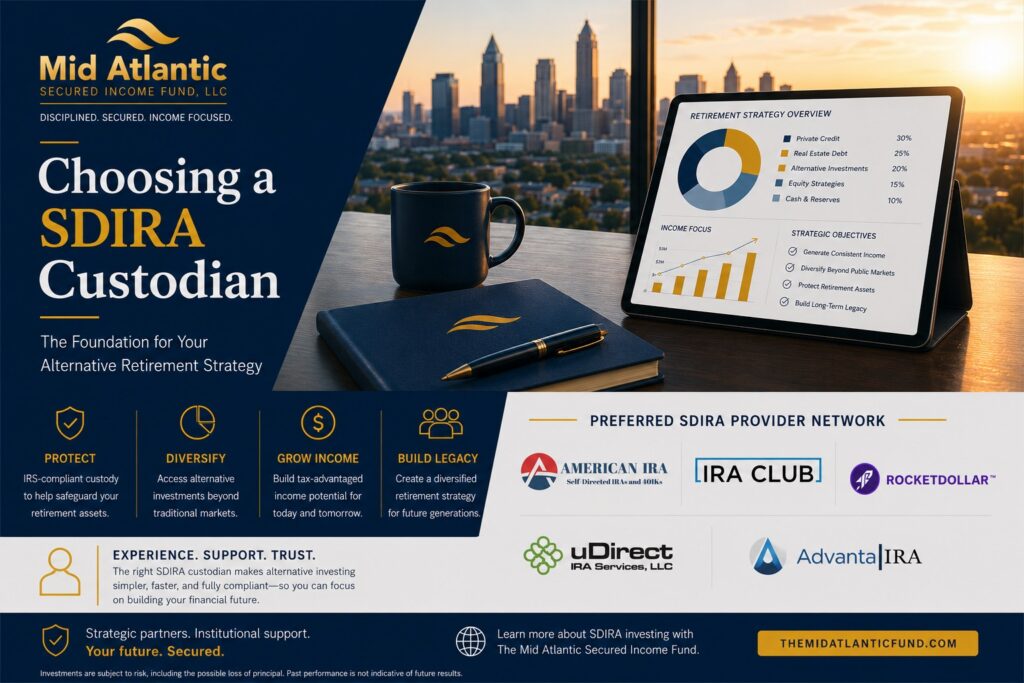
Mid Atlantic Fund Preferred SDIRA Provider Network
The Mid Atlantic Secured Income Fund works with several recognized SDIRA custodial platforms and retirement service providers familiar with alternative investment administration.
These relationships are designed to help streamline the investor experience for eligible retirement investors exploring alternative investments through SDIRAs.
Commonly referenced custodial and retirement partners include:
These providers each offer varying:
- account structures,
- fee models,
- digital experiences,
- and operational approaches.
Investors should independently evaluate which provider best aligns with:
- investment goals,
- retirement objectives,
- account size,
- transaction frequency,
- and operational preferences.
Additional information regarding retirement investing and SDIRA partnerships can be found at:
Mid Atlantic IRA Investing Resource Center
What Types of Investments Can SDIRAs Hold?
SDIRAs can generally hold a broader range of alternative investments compared to traditional brokerage IRAs.
Common SDIRA investment categories include:
- private credit,
- private lending,
- real estate-backed debt,
- multifamily real estate,
- private real estate syndications,
- tax liens,
- precious metals,
- infrastructure,
- and alternative income investments.
However, IRS rules prohibit certain asset categories and prohibited transactions.
Investors should always consult qualified tax and legal professionals regarding retirement account compliance requirements.
SDIRA Rules Investors Should Understand
Understanding SDIRA compliance rules is critical.
Key considerations include:
Prohibited Transactions
The IRS prohibits certain self-dealing activities involving retirement accounts.
Examples may include:
- personally benefiting from IRA-owned property,
- using IRA assets improperly,
- or transacting with disqualified persons.
Unrelated Business Taxable Income (UBTI)
Certain investments may generate UBTI exposure within retirement accounts.
This can apply in:
- leveraged real estate structures,
- operating businesses,
- and certain partnership arrangements.
Investors should consult tax professionals regarding UBTI implications.
Custodian Limitations
Custodians generally administer transactions but do not provide:
- investment recommendations,
- underwriting opinions,
- legal advice,
- or tax guidance.
Investors remain responsible for investment due diligence.
Why Accredited Investors Are Using SDIRAs for Private Credit
Private credit has become one of the fastest-growing alternative investment categories globally.
According to institutional research from Preqin and Goldman Sachs, investors increasingly allocate toward private lending due to:
- income generation,
- diversification,
- and lower public market correlation.
Within SDIRAs, private credit investments may provide:
- recurring interest income,
- alternative yield exposure,
- and diversified retirement portfolio construction.
Many accredited investors utilize SDIRAs to access:
- secured lending structures,
- real estate-backed loans,
- and institutional alternative income strategies.
How SDIRAs Fit Into Strategic Retirement Planning
Modern retirement planning increasingly emphasizes:
- diversification,
- income resilience,
- inflation awareness,
- and long-term capital preservation.
Many investors are moving beyond the traditional stock-and-bond-only framework toward broader portfolio construction strategies incorporating alternative investments.
SDIRAs may help facilitate this diversification within tax-advantaged retirement structures.
Questions Investors Should Ask Before Choosing a Custodian
Before selecting a SDIRA custodian, investors should consider asking:
- How experienced is the custodian with alternative investments?
- How quickly are transactions typically processed?
- What are the annual and transaction fees?
- Does the provider offer digital account management?
- How experienced is the support team?
- Does the custodian regularly handle private placements and private credit?
- What educational resources are available?
- How scalable is the platform for long-term retirement investing?
Common Mistakes Investors Make
Choosing Based Solely on Lowest Fees
Operational quality and responsiveness often matter significantly in alternative investing environments.
Not Understanding Processing Timelines
Alternative investments frequently require:
- subscription documents,
- funding approvals,
- and coordinated transaction workflows.
Ignoring Custodian Experience
Custodians unfamiliar with private credit or alternative investments may create administrative friction.
Failing to Understand Compliance Rules
SDIRA investors remain responsible for avoiding prohibited transactions and understanding retirement account regulations.
Are SDIRAs Only for Wealthy Investors?
No.
While many accredited investors utilize SDIRAs for alternative investments, self-directed retirement accounts are used across a broad range of investor profiles.
However, SDIRAs are often most beneficial for investors seeking:
- broader diversification,
- alternative investments,
- and long-term retirement portfolio customization.
The Future of SDIRA Investing
Several macro trends continue driving SDIRA growth:
- rising interest in private credit,
- increased retirement diversification,
- institutional adoption of alternatives,
- higher demand for income-focused investing,
- and growing awareness of alternative retirement strategies.
As alternative investing becomes more mainstream, SDIRAs are likely to remain an increasingly important component of retirement portfolio construction.
Conclusion
Choosing a SDIRA custodian is a strategic decision that can materially influence the retirement investing experience.
For accredited investors exploring:
- private credit,
- secured lending,
- alternative income strategies,
- and diversified retirement planning,
the right custodian may improve operational efficiency, transaction execution, and long-term portfolio management.
As retirement investing continues evolving beyond traditional public market allocations, SDIRAs are increasingly becoming valuable tools for accessing alternative investments within tax-advantaged structures.
Sophisticated investors increasingly recognize that long-term retirement planning is not solely about maximizing returns — it is about building durable, diversified, and resilient portfolios capable of navigating changing economic environments across decades.
FAQ Section
What is a SDIRA custodian?
A SDIRA custodian is a financial institution responsible for administering self-directed retirement accounts and maintaining IRS compliance for alternative investments held within the account.
What investments can a SDIRA hold?
SDIRAs may hold alternative investments including private credit, real estate, private lending, tax liens, and private placements, subject to IRS rules.
Why do investors use SDIRAs?
Investors use SDIRAs to diversify retirement portfolios beyond traditional stocks and bonds and gain access to alternative investments.
What should investors look for in a SDIRA custodian?
Important considerations include:
- experience with alternative investments,
- transaction efficiency,
- fee transparency,
- technology infrastructure,
- and investor support quality.
Are SDIRAs tax advantaged?
Yes. SDIRAs generally retain the same tax advantages associated with traditional IRAs and Roth IRAs depending on account structure.
Can SDIRAs invest in private credit?
Yes. Many accredited investors use SDIRAs to access private credit and alternative income-oriented investments.