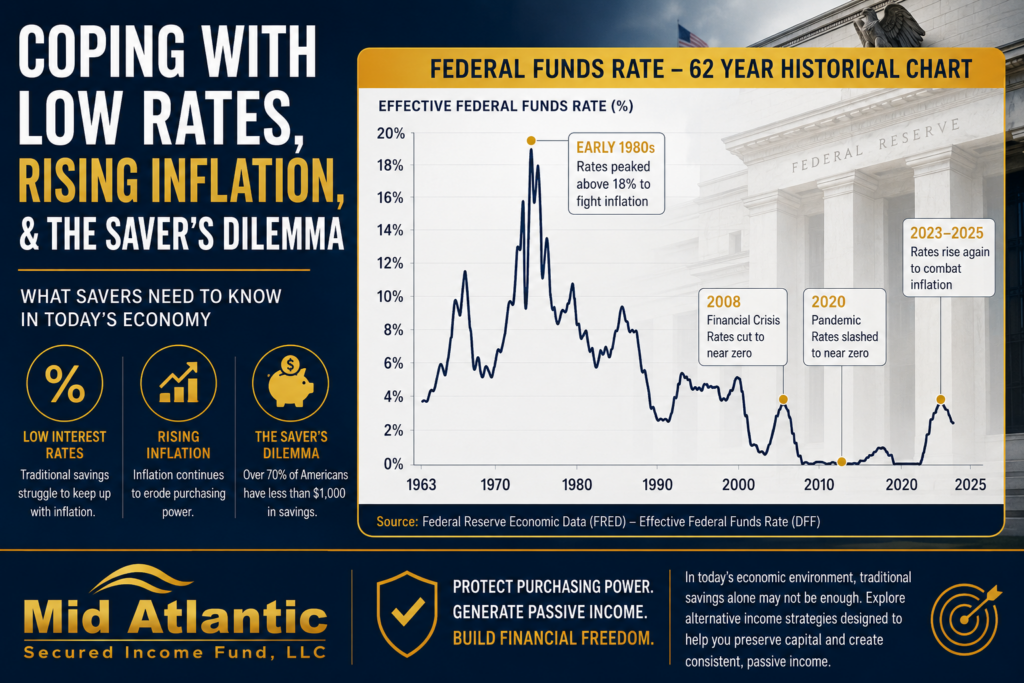

A period of inflation changes more than the price of goods and services. It changes the standard investors should apply to every source of income, every valuation, and every assumption about liquidity. The best investments during inflation are not simply the assets with the highest stated return. For accredited investors, the more useful question is whether an investment’s structure, collateral, duration, and risk controls remain understandable when purchasing power is under pressure.
That distinction matters in private markets. Income can be attractive, but it should be evaluated alongside borrower quality, lien position, asset coverage, manager discipline, expenses, and the practical ability to access capital when needed. Inflation can expose weak underwriting just as quickly as it can create opportunity.
Inflation is a capital-preservation test
Inflation reduces the buying power of cash over time. It may also affect interest rates, property values, construction costs, tenant demand, consumer spending, and the availability of credit. Those effects do not move in a straight line, and they do not affect every asset class equally.
For investors focused on current income, the central issue is real return: whether income and potential appreciation, after fees, taxes, and inflation, support the investor’s objectives. That calculation is personal. A family office with a long investment horizon may accept a degree of illiquidity that an investor funding near-term obligations should not. A self-directed IRA investor must also consider account rules and available liquidity without assuming that a private investment can be readily redeemed.
Inflation is therefore not a reason to abandon discipline or make broad asset-class bets. It is a reason to revisit portfolio construction and ask where the investor is being compensated for the risks being accepted.
Best investments during inflation begin with structure
No single investment is appropriate for every investor or every inflationary environment. Still, several characteristics tend to deserve closer attention when evaluating private-market income and real estate credit opportunities.
Senior position and defined collateral
A senior-secured loan is structured with a priority claim on identified collateral relative to more junior capital in the capital stack. In real estate lending, a first-position lien can provide an important structural protection, although it does not eliminate the possibility of loss. Collateral value may decline, a borrower may default, workout costs may arise, and foreclosure or disposition can take time.
The relevant diligence goes beyond the label “secured.” Investors should understand what secures an obligation, how the collateral was evaluated, the quality of title and insurance review where applicable, and what could impair recovery in an adverse scenario. A first-position real estate loan and an unsecured operating-company obligation should not be assessed by the same framework simply because both offer income.
Underwriting that allows for changing conditions
Inflation can increase renovation budgets, carrying costs, insurance expenses, and the cost of completing a development project. It can also alter the financing options available to a borrower at maturity. Disciplined underwriting should account for those possibilities rather than relying only on a favorable base-case outcome.
For private real estate credit, investors may wish to review how a manager evaluates borrower experience, property condition, project scope, marketability, exit assumptions, and the sources of borrower equity. The goal is not to predict every economic shift. It is to determine whether the underwriting process identifies downside risks before capital is committed.
Duration and repricing considerations
Fixed-income investments can be sensitive to changes in prevailing rates. In broad terms, longer-duration obligations may be more exposed when rates rise, while shorter-duration lending may allow capital to be redeployed as loans repay. That is a structural consideration, not a promise of better outcomes.
Private loans also introduce timing uncertainty. A loan may repay early, extend under permitted terms, require a workout, or face delays related to the underlying collateral. Investors should read the governing documents carefully to understand how loan maturities, extensions, repayments, and reinvestment decisions can affect the investment experience.
Income is not the same as liquidity
Private credit and private real estate funds can offer exposure that differs meaningfully from publicly traded securities, but that difference includes illiquidity. Interests in a private fund may not be readily transferable, and any repurchase or redemption process is governed by the applicable offering documents and may be limited.
Liquidity planning should happen before an investment is made. Investors should avoid treating private-market income as a substitute for emergency reserves or capital needed for known near-term expenses. A higher stated income objective does not overcome a mismatch between the investment’s liquidity profile and the investor’s needs.
Where senior-secured real estate credit may fit
Senior-secured, first-position real estate lending may be relevant to accredited investors seeking to evaluate income-oriented private credit alongside other portfolio holdings. Its potential role rests on the quality of the loans, the strength of the underwriting, the collateral, the manager’s servicing practices, and the terms of the fund or offering.
A fund strategy focused on capital preservation may seek to emphasize senior lien priority and real estate collateral. Those features can help define the investment approach, but they are not assurances of principal preservation, distributions, or performance. Real estate values can change, borrowers can encounter financial difficulty, and legal or operational issues can affect outcomes.
At Mid Atlantic Secured Income Fund, investors evaluating the fund should review current offering materials, risk disclosures, fee information, portfolio-construction approach, and reporting practices. Eligibility requirements apply, and a prospective investor should confirm accredited-investor status and assess suitability with qualified legal, tax, and financial advisers.
Transparent reporting is especially valuable in uncertain conditions. Investors should look for clear communication about portfolio composition, loan status, realized and unrealized risks, concentration, and material developments. Transparency does not remove risk, but it supports more informed oversight.
Do not confuse a fund strategy with borrower financing
Alternative lending platforms may provide business-purpose financing for qualified borrowers across several use cases, including commercial bridge lending, acquisition and construction financing, renovation and redevelopment projects, site and land development, lot acquisition, and fix-and-flip projects. Other business-purpose products may address receivables, purchase orders, inventory, automotive businesses, litigation-related financing, or working-capital needs.
These borrower financing products serve distinct commercial needs and are evaluated under product-specific underwriting criteria. Eligibility, collateral, documentation, terms, and availability vary. A borrower-facing financing product should not be assumed to be held by, collateralize, or generate returns for an investment fund unless current offering and transaction documentation expressly confirms that relationship.
This separation is essential for sound diligence. Investors should evaluate the fund they are considering, not extrapolate from the broader lending platform’s product menu. Likewise, qualified borrowers should evaluate financing based on their business purpose, repayment capacity, collateral, documentation, and project requirements rather than viewing a financing application as an investment opportunity.
Questions to ask before allocating capital
A disciplined review should concentrate on the details that determine risk. How is the investment structured? What assets or obligations are expected to support investor returns? What is the priority of the fund’s position in the capital stack? How are loans sourced, underwritten, monitored, serviced, and resolved if performance deteriorates?
Investors should also examine concentration. Exposure to a single borrower, property type, geography, loan maturity period, or economic driver can affect results even when individual loans appear well secured. They should understand management fees, organizational expenses, conflicts of interest, valuation policies, and the circumstances under which capital may remain invested longer than expected.
For self-directed IRA investors, operational diligence deserves equal attention. Custody processes, prohibited-transaction concerns, documentation, and account administration should be reviewed with appropriate advisers before committing capital. This is not individualized tax, legal, or retirement-account advice.
Past performance, if presented in approved materials, does not guarantee future results. Projections, target returns, and illustrative scenarios should be treated as assumptions to test, not outcomes to rely upon.
A measured response to an uncertain environment
Inflation rewards clarity more than prediction. An investor does not need to forecast every central-bank decision or property-market turn to improve decision-making. The practical work is to understand the investment’s legal structure, collateral, underwriting standards, liquidity constraints, fees, and downside scenarios.
When capital preservation is a priority, patience is a valid investment decision. Review the offering documents, ask direct questions, compare risks rather than headlines, and commit capital only when the investment fits the portfolio’s objectives, time horizon, and capacity for loss.