
A portfolio built solely around public stocks and conventional bonds can leave income-focused investors exposed to two uncomfortable realities: market-price volatility and changing interest-rate expectations. Asset backed passive income offers a different framework. Rather than relying primarily on market appreciation or an issuer’s general promise to pay, the strategy seeks income from loans supported by identifiable collateral, often real estate.
For accredited investors, the attraction is not simply a higher stated yield. It is the opportunity to evaluate how income is generated, what secures the obligation, how long capital may be committed, and what procedures stand behind each loan. Those details determine whether an income investment is appropriately aligned with a capital-preservation mandate.
What Asset Backed Passive Income Means
Asset backed passive income is income produced by investments tied to underlying assets that may provide a source of recovery if a borrower does not meet its obligations. In private real estate credit, an investor’s capital may be deployed into short-term loans secured by residential or commercial property. The borrower makes interest payments under the loan agreement, and investors may receive distributions from the interest collected by the fund or lending vehicle.
This differs materially from owning rental property directly. A landlord must acquire, maintain, lease, insure, and ultimately sell a building. A private credit investor is generally financing a borrower who assumes the operational responsibility for the project. The investor’s focus shifts from managing real estate to assessing the quality of the loan, the collateral, the borrower’s plan, and the lender’s servicing discipline.
It also differs from equity-style real estate investing. Equity returns often depend on property appreciation, rental growth, refinancing conditions, or a favorable sale. Credit investors are generally positioned to receive contractual interest payments and repayment of principal according to loan terms. That can create a clearer income profile, although it does not remove the possibility of default, delay, or loss.
Why Collateral Matters in an Income Strategy
Collateral is not a substitute for careful underwriting. It is the second line of defense after a borrower’s capacity and willingness to perform. A well-structured real estate loan should be evaluated on the borrower’s experience, project economics, exit strategy, title position, property condition, local market conditions, and realistic value of the collateral.
First-position mortgage liens are especially relevant because lien priority affects who has the first claim on proceeds if a property must be sold or foreclosed upon. When a lender holds a first-position lien, it is ahead of junior debt and equity in the repayment hierarchy. That priority can be meaningful, but it is only as strong as the documentation, valuation, and enforcement process supporting it.
Loan-to-value ratio is another core control. A loan originated at a conservative percentage of a property’s current or supportable value provides a margin of safety against valuation changes, construction setbacks, and sale costs. For example, lenders using loan-to-value ranges of roughly 65% to 75% are leaving more equity beneath the loan than a lender financing nearly all of a project’s value. The appropriate ratio depends on the asset type, project stage, borrower strength, and liquidity of the local market.
The discipline is not in describing collateral as “hard.” The discipline is in asking what that asset could reasonably be worth, how quickly it could be monetized under stress, and whether the loan balance still allows room for an orderly recovery.
How Private Real Estate Credit Generates Cash Flow
Short-duration private mortgage loans are commonly used for construction, renovation, redevelopment, bridge financing, or other transitional business needs. These borrowers may need speed, flexibility, or a loan structure that conventional banks are not positioned to provide. In exchange, they typically pay interest at rates that reflect the loan’s complexity, duration, and risk.
A fund that originates and services these loans can pool capital across multiple transactions. Investors then gain exposure to a managed portfolio rather than having to underwrite, document, fund, and administer each loan individually. Depending on the offering terms, income may be distributed monthly or semi-annually.
Short loan durations can be useful when interest rates and property markets are changing. Capital may return and be redeployed more frequently than in long-dated real estate holdings. Still, shorter duration does not mean daily liquidity. Private investments generally involve transfer restrictions, subscription requirements, and redemption provisions that deserve close attention before capital is committed.
For investors seeking retirement income, the practical appeal is straightforward: a portfolio of performing loans may create a source of current cash flow that is not dependent on selling appreciated securities. The trade-off is that private credit requires diligence around manager selection, liquidity, fees, conflicts, and the quality of the underlying loans.
The Underwriting Questions That Deserve Attention
Income investors should resist evaluating a private credit opportunity by distribution rate alone. A stated return is an outcome, not an underwriting standard. The more useful question is what conditions must remain true for that return to be paid and principal to be repaid.
Start with the lender’s sourcing and approval process. Does the manager independently assess property value, review title and insurance, verify the borrower’s contribution, and establish a credible repayment path? In a construction or renovation loan, the analysis should also address budgets, draw controls, contractor experience, permits, contingency reserves, and progress monitoring.
Then consider portfolio construction. Concentration in one borrower, property type, geography, or project stage can magnify risk. A diversified loan portfolio may reduce the impact of an individual problem loan, though diversification cannot prevent losses. Investors should understand the fund’s authority to make loans, maximum concentration limits, use of leverage if any, and procedures for handling extensions or defaults.
Finally, assess servicing. Origination is only the beginning of credit management. Strong servicing includes collecting payments, monitoring collateral, tracking insurance and taxes, reviewing project progress, documenting covenant compliance, and acting promptly when a loan is not performing as expected. A lender’s experience through difficult situations can be more revealing than its marketing during favorable markets.
Asset Backed Passive Income and Retirement Capital
Accredited investors with rollover IRAs, self-directed IRAs, or former employer retirement accounts may consider private real estate credit as one component of a broader income allocation. The potential benefit is access to an asset class that may behave differently from publicly traded fixed-income securities and does not require the investor to operate real estate directly.
However, retirement-account investing adds administrative requirements. The custodian must permit the investment, offering documents must be reviewed carefully, and investors should understand valuation, reporting, distribution timing, and liquidity terms. Certain transactions can create prohibited-transaction concerns or other tax consequences depending on the account structure and the investor’s relationship to borrowers or properties. A qualified tax professional and IRA custodian can help evaluate those issues before an investment is made.
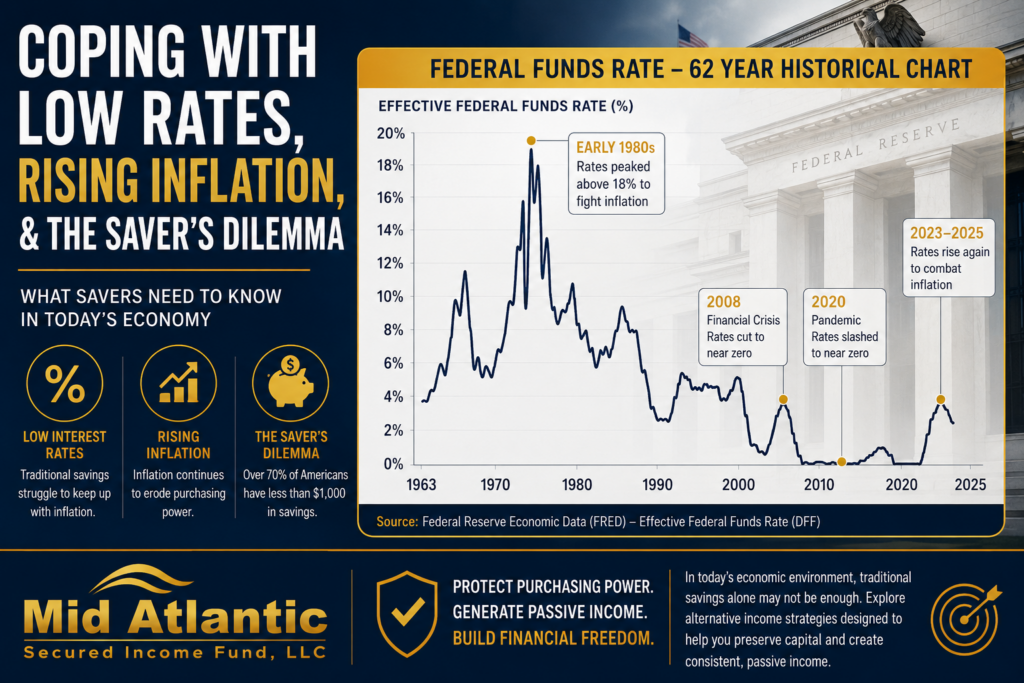
The Federal Reserve’s interest-rate policy, bank lending standards, and regional property conditions can all affect the private credit environment. When banks tighten lending, demand for private financing may increase. Yet tighter conditions can also signal greater stress for borrowers. That is why a disciplined lender does not treat greater demand as a reason to relax standards.
The Risks That Should Remain Visible
Real estate-backed lending is designed to prioritize contractual income and collateral protection, but it is not risk-free. Property values can decline, construction can be delayed, borrowers can default, and legal enforcement can take longer or cost more than expected. Interest payments may be interrupted, distributions may change, and investors may not be able to access capital on their preferred timetable.
There is also manager risk. Investors are relying on the fund sponsor to originate prudently, service consistently, communicate accurately, and manage conflicts responsibly. Reviewing offering documents, historical lending experience, underwriting standards, servicing capabilities, and alignment of interests is essential. Past distributions and prior performance can provide context, but they do not predict future results.
A suitable allocation depends on an investor’s liquidity needs, time horizon, existing holdings, risk tolerance, and ability to evaluate private placement documents. Private credit is generally best treated as a deliberate allocation within a diversified strategy, not as a replacement for readily available reserves or a vehicle for pursuing unrealistic returns.
A More Disciplined Way to Pursue Income
The strongest case for real estate-backed private credit is not that it eliminates uncertainty. It is that it gives investors a structure for managing uncertainty: contractual interest, identifiable collateral, lien priority, conservative leverage, and active loan oversight. Firms such as Mid Atlantic Secured Income Fund apply this framework by focusing on short-term, first-position loans and underwriting designed to put risk management ahead of volume.
For an investor evaluating asset backed passive income, the right next question is not “What is the highest yield available?” It is “What protects the income, what protects principal, and how has the manager prepared for the loan that does not go as planned?” That mindset keeps the focus where it belongs: on durable cash flow supported by disciplined credit decisions.