
A 50-basis-point move in rates can change far more than borrowing costs. It can alter project timelines, buyer demand, refinancing options, cap rates, and ultimately the margin of safety behind a real estate loan. That is why economic trends affecting real estate matter not only to property owners, but also to accredited investors evaluating income-producing private credit strategies.
For investors focused on stability, the right question is not whether real estate will always appreciate. The more useful question is how changing economic conditions affect collateral values, borrower performance, loan demand, and exit liquidity. In a market shaped by inflation pressure, tighter bank credit, and uneven regional growth, disciplined underwriting matters more than broad market narratives.
Why economic trends affecting real estate matter to credit investors
Real estate is often discussed as a single asset class, but market behavior is highly segmented. Residential construction in a supply-constrained market behaves differently from suburban office. A bridge loan on a well-located infill redevelopment carries different risk than long-duration ownership of a stabilized asset purchased at an aggressive basis.
For investors in real estate-backed private credit, economic conditions filter through a different lens than they do for equity owners. The focus is less about maximizing upside and more about preserving principal, maintaining current income, and structuring loans with enough protection if conditions weaken. This is where conservative loan-to-value ratios, first-position security, and short durations become especially relevant.
Interest rates remain the most immediate force
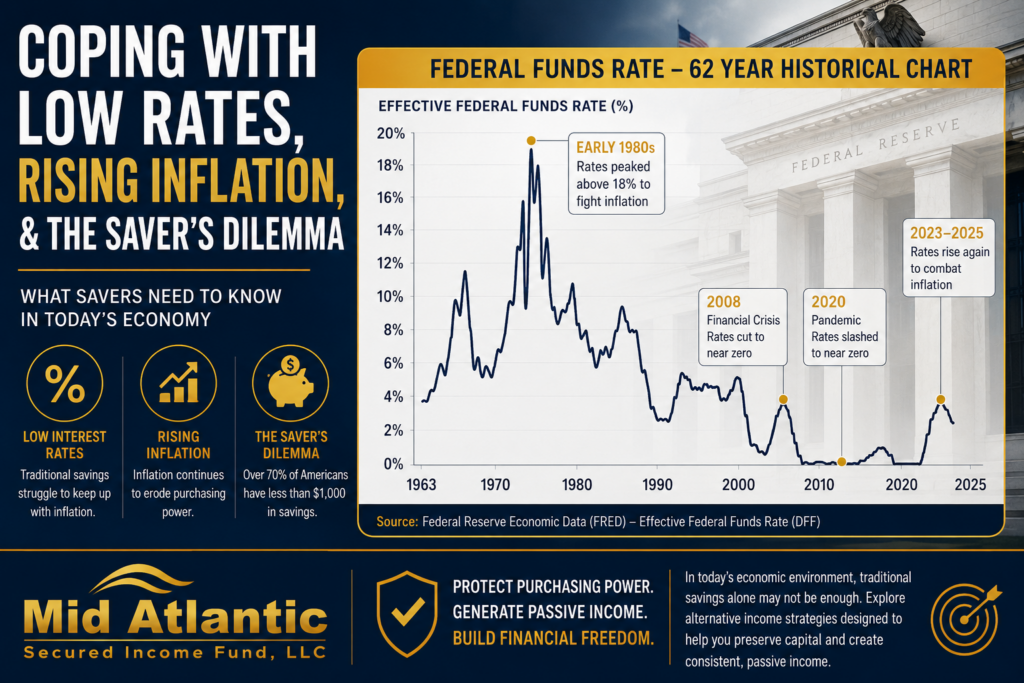
Federal Reserve policy continues to influence every layer of the real estate capital stack. Higher benchmark rates have raised the cost of bank financing, construction debt, and permanent loans. According to Federal Reserve and Mortgage Bankers Association data over the past rate cycle, elevated financing costs have reduced transaction volume, increased debt service burdens, and pressured valuations in rate-sensitive sectors.
For property owners, higher rates can compress cash flow and make refinancing more difficult. For borrowers seeking short-term capital, that can increase demand for bridge loans, renovation financing, and other flexible structures when traditional lenders slow down. But higher rates also require more caution. A loan that looked well covered when takeout financing was readily available may warrant a different structure when permanent debt is more expensive and lender standards are tighter.
This is one of the clearest examples of it depends. Rising rates can create attractive lending opportunities, but only when underwriting reflects realistic exit assumptions. If borrowers are relying on optimistic resale values or easy refinancing, the risk profile changes quickly.
What rates do to valuations and liquidity
When financing costs rise, buyers typically pay less for the same income stream. That adjustment shows up in cap rates, deal pricing, and lower transaction activity. In some sectors, values may remain relatively resilient because of limited supply or strong rent growth. In others, price discovery takes longer, and liquidity can thin out.
For a private credit investor, lower liquidity is not automatically negative. In fact, a reduced bank appetite can create room for experienced lenders to command stronger structures, better pricing, and more protective covenants. The trade-off is that underwriting discipline has to increase as market exits become less predictable.
Inflation affects real estate in uneven ways
Inflation is often described as favorable for real assets, but that statement needs context. Some property types can pass through higher costs through rent increases. Others cannot, at least not quickly. Meanwhile, inflation raises labor costs, materials pricing, insurance premiums, taxes, and operating expenses.
In construction and redevelopment, the impact is especially direct. A project budget underwritten six months earlier may no longer reflect current reality if framing, mechanical systems, or subcontractor labor costs move materially. That can reduce borrower contingency, pressure timelines, and increase the chance that additional capital is needed before completion.
For lenders, inflation changes the importance of sponsor experience, project monitoring, and draw controls. It also reinforces the value of lending against real collateral at conservative leverage rather than stretching proceeds based on best-case assumptions.
For income-oriented investors, inflation introduces a second issue: purchasing power. Traditional fixed-income products may not keep pace when inflation remains elevated. That is one reason some accredited investors look to shorter-duration, asset-backed private credit strategies that may reset pricing more efficiently than long-term bonds. The point is not that private credit removes inflation risk. It is that duration, collateral, and loan structure can offer a different risk and income profile.
Credit tightening is reshaping borrower behavior
Bank lending standards matter as much as benchmark rates. Federal Reserve surveys have repeatedly shown periods of tighter credit availability for commercial and residential real estate lending. When banks reduce exposure, lower advance rates, or lengthen approval timelines, borrowers often turn to nonbank lenders for speed, certainty, or financing tailored to transitional assets.
That shift creates opportunity, but it also separates disciplined operators from yield chasers. If banks are stepping back because a deal lacks clarity, an alternative lender should not treat that as a reason to lower standards. The better approach is to identify situations where the borrower has a credible business plan, meaningful equity, and a property with demonstrable value support.
This environment tends to favor lenders that can underwrite from the collateral outward. Income matters. Sponsorship matters. But in stressed scenarios, security interest, basis, and recoverability matter most.
Labor markets and consumer health still drive local outcomes
National headlines rarely tell the full story. Real estate performance is deeply local, and labor market conditions remain a foundational driver of both residential and commercial demand. Job growth, wage growth, household formation, and business expansion all affect occupancy, rent collections, and sale activity.
A healthy labor market can support housing demand even in a higher-rate environment, particularly in regions benefiting from migration, logistics growth, healthcare expansion, or new industrial investment. At the same time, consumer stress can appear before broad employment weakness becomes obvious. Rising delinquencies in other forms of credit, softer discretionary spending, or declining small-business confidence can all work their way into tenant demand and borrower performance.
For investors, this argues against overreliance on national averages. A disciplined lender pays attention to submarket-level supply, employment drivers, absorption trends, and comparable sale data. Real estate remains local, even when macro forces dominate the headlines.
Supply constraints support some sectors and pressure others
Supply is one of the most underappreciated economic trends affecting real estate. In housing, years of underbuilding in many markets have helped support values and rents despite affordability pressure. In industrial, demand tied to logistics and inventory positioning has supported select markets, though not uniformly. In office, oversupply and structural demand shifts have combined to create a much more difficult backdrop.
This matters because collateral quality is sector-specific. A lender secured by a well-located residential asset with clear demand drivers may be in a very different position than one exposed to commodity office space facing elevated vacancy and tenant rollover risk.
The lesson for private credit investors is straightforward. Real estate exposure should not be viewed as generic. Asset type, market depth, replacement cost, local supply pipelines, and probable liquidation paths all influence risk.
How disciplined lenders respond
Periods of economic transition reward process, not prediction. No lender controls Fed policy, inflation prints, or regional absorption. What can be controlled is loan structure.
That usually means lower leverage, independent valuation support, careful sponsor review, realistic interest reserves where needed, and underwriting that assumes friction in the exit. It also means shorter durations can be helpful when the macro picture is uncertain. A lender making short-term first-position loans may have more flexibility to reprice risk and reassess market conditions than an investor locked into a long-duration instrument.
At Mid Atlantic Secured Income Fund, that general discipline is central to how real estate-backed private credit is approached: collateral first, conservative leverage, and a clear focus on capital preservation alongside current income. In uncertain markets, those principles are not marketing language. They are operational necessities.
What investors should watch next
The next phase of the market will likely be shaped by a combination of rate policy, refinancing pressure, and regional economic divergence. If inflation cools and rates ease modestly, transaction volume may improve. If credit conditions stay tight, private lenders may continue to see strong demand. If growth slows meaningfully, collateral selection and borrower quality will become even more important.
That is why investors evaluating alternative income strategies should look beyond headline yields. The better questions are practical. What stands behind the loan? How much equity is beneath the lender? How sensitive is the business plan to rates, time, and cost overruns? What does repayment depend on? And how experienced is the manager in protecting capital when markets stop cooperating?
Economic cycles do not eliminate opportunity in real estate. They simply make structure, discipline, and margin of safety far more valuable than optimism.