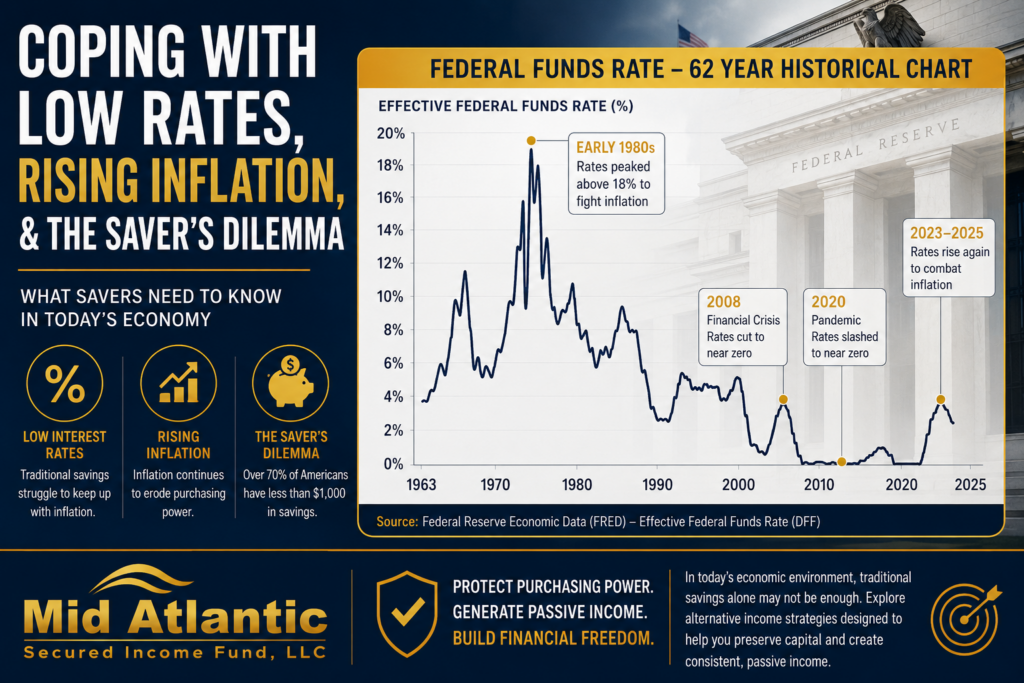

Public-market volatility can change portfolio values quickly, but the more consequential question for many accredited investors is whether they understand the risks in assets that do not reprice every day. Effective market volatility strategies begin with that distinction. A stable reported value does not eliminate credit risk, real estate risk, liquidity risk, or the possibility of loss.
For investors considering private real estate credit, the objective should not be to predict the next market move. It should be to establish a disciplined framework for evaluating income potential, collateral, underwriting, concentration, and access to capital under a range of conditions. That framework is particularly relevant when an allocation is designed around capital preservation objectives rather than short-term trading.
Market Volatility Strategies Start With Risk Definition
Volatility is often treated as a single measure of price movement. For private credit investors, it is more useful to separate volatility from impairment risk. Public securities may fluctuate daily because of changes in sentiment, interest-rate expectations, or liquidity. Private loans are generally valued differently, often with less frequent observable pricing. Their economic risk is instead tied more directly to borrower performance, collateral value, loan documentation, servicing, and the path to repayment.
That difference creates a trade-off. Less frequent valuation movement may make a private investment feel steadier, but it can also make it harder for an investor to observe changing conditions in real time. Investors should therefore look beyond reported stability and ask how the manager monitors credit quality, collateral, and borrower performance when market conditions shift.
Senior-secured, first-position real estate lending can offer a defined collateral framework, but lien priority alone does not determine an outcome. The value, marketability, condition, and legal status of the collateral matter. So do the borrower’s plan, the quality of the project, the adequacy of documentation, and the manager’s ability to administer a loan through both expected and adverse scenarios.
Focus on Underwriting Before Income
A private credit allocation should be evaluated as an underwriting decision before it is evaluated as an income decision. Current income can be attractive to investors seeking alternatives to publicly traded bonds or equities, but it is not a substitute for analyzing the risk supporting that income.
A disciplined underwriting process should address the borrower, the property, the proposed use of proceeds, the repayment source, and the structure of the loan. In real estate lending, that may include a review of property condition, title and lien position, insurance, local market considerations, construction or renovation plans where applicable, and the borrower’s capacity to execute the business plan.
Investors should also consider how underwriting assumptions could perform under pressure. If a sale takes longer than expected, refinancing becomes more difficult, construction costs rise, or demand softens in a local market, what protections and remedies are available? No single question resolves every risk. Together, however, they reveal whether a lender has built a process around downside analysis instead of favorable-case assumptions.
This is where collateral quality becomes central. A first-position security interest may be meaningful only if the collateral can be understood, documented, monitored, and, if necessary, addressed through an orderly workout process. Real estate is local, and collateral analysis should reflect that reality rather than rely on broad national narratives.
Match Liquidity to the Investment Horizon
Private credit is not a substitute for cash or readily tradable securities. Investors should treat liquidity as a portfolio-design issue, not as a disclosure footnote. Before committing capital, an investor should understand the investment’s holding period, transfer restrictions, redemption provisions if any, potential limitations on withdrawals, and the circumstances in which capital may remain invested longer than anticipated.
The appropriate allocation depends on the investor’s own liquidity needs, time horizon, and tolerance for uncertainty. A family office with long-duration capital may approach an illiquid private investment differently than an individual funding near-term obligations. Self-directed IRA investors should also consider operational requirements and consult qualified tax, legal, and retirement-account advisers before making decisions.
A practical approach is to reserve liquid capital for known expenses, contingencies, and opportunities before allocating to an illiquid vehicle. That does not make a private investment suitable for every investor. It does help prevent an investor from placing short-term needs alongside assets that may require patience.
Evaluate the Manager, Not Just the Asset Type
Private credit outcomes depend heavily on manager execution. A strategy that sounds conservative in a presentation can still carry meaningful risk if underwriting, servicing, valuation, or reporting practices are inconsistent.
Due diligence should extend to the manager’s decision-making process. Investors can request and review offering documents, risk disclosures, fee information, governance materials, and reporting examples. They should understand who originates loans, who approves exceptions, how conflicts are addressed, how loans are serviced, and how the manager communicates when a loan does not perform as expected.
The following questions can help organize that review:
- How does the manager define acceptable collateral and seniority of lien?
- What underwriting factors are required before a loan is approved?
- How are borrower performance and property-level developments monitored after closing?
- How are valuations determined and reviewed?
- What reporting does the investor receive regarding portfolio composition, concentration, liquidity, and material developments?
- How are extensions, modifications, defaults, and workouts evaluated and disclosed?
Transparent reporting is not merely a communications preference. It allows investors and their advisers to assess whether the portfolio continues to align with the strategy presented at the time of investment. Reporting cannot remove risk, but a clear reporting discipline can support informed oversight.
Diversification Requires More Than a Loan Count
A portfolio may hold multiple loans and still be exposed to concentrated risks. Investors should consider concentration by property type, geography, borrower, loan maturity, and repayment source. A group of loans can appear diversified while sharing the same exposure to a local real estate market, refinancing conditions, construction activity, or borrower segment.
Diversification also has limits. It may reduce the effect of a single adverse outcome, but it does not prevent broad market stress or eliminate losses. The more useful question is whether the portfolio’s concentrations are identified, intentional, and consistent with the investor’s objectives.
For an investor evaluating a private credit fund, the fund’s actual investment parameters and portfolio practices should be confirmed in its current offering documents. Investors should not assume that every loan type marketed through an affiliated or related lending platform is held by, collateralizes, or generates returns for a particular fund.
Keep Investor and Borrower Decisions Separate
A lending platform may offer qualified borrowers business-purpose financing across several use cases, including commercial bridge loans, acquisition or construction financing, renovation and redevelopment lending, site and land development financing, lot acquisition and fix-and-flip loans, receivables financing, purchase-order funding, inventory financing, commercial automotive financing, and working-capital solutions.
Those financing products serve borrower needs and are evaluated according to their own underwriting, documentation, collateral, and eligibility considerations. Availability and terms vary by transaction. They should not be presented as an investor return product or presumed to be part of a private credit fund portfolio unless current approved fund documentation expressly confirms that relationship.
For qualified real estate borrowers, volatility planning often means maintaining complete project documentation, realistic timelines, clear sources of repayment, and contingency plans when costs or market conditions change. For operating businesses, it can mean matching financing to the underlying business cycle, receivables, inventory, or purchase order rather than using short-term capital to solve a long-duration problem.
Build a Decision Process That Can Withstand Uncertainty
The most useful market volatility strategies are usually procedural rather than predictive. Establish an allocation range, define liquidity reserves, review offering materials carefully, and document the reasons an investment fits a broader portfolio plan. Revisit those assumptions periodically, particularly when personal circumstances, real estate conditions, or financing markets change.
Mid Atlantic Secured Income Fund frames its approach around Safe, Simple, Secured as positioning grounded in disciplined underwriting, collateral quality, and transparent investor communication. Investors should still review the applicable offering documents in full, consider all risks and fees, and consult qualified advisers regarding their individual circumstances.
Market conditions will change, often without warning. A durable response is not to chase certainty, but to insist on clear underwriting, understandable collateral, appropriate liquidity planning, and reporting that gives investors a meaningful basis for oversight.