
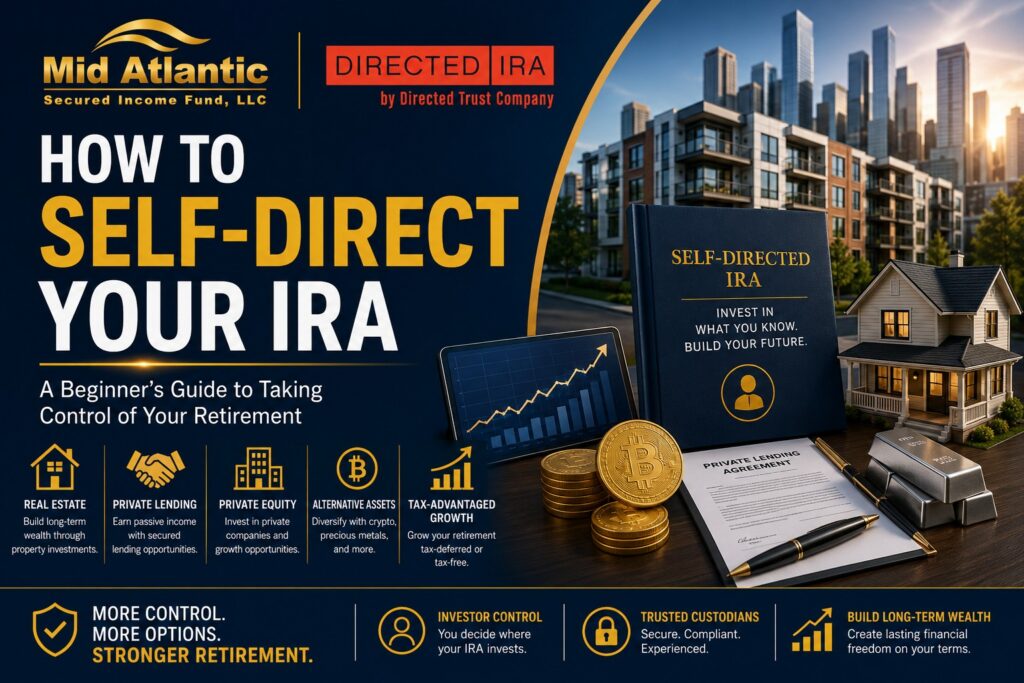
How to Self-Direct Your IRA: A Beginner’s Guide to Taking Control of Your Retirement
Looking Beyond Stocks and Mutual Funds?
Most investors build their retirement accounts using traditional investments such as stocks, bonds, mutual funds, and ETFs. While these investments can play an important role in a retirement portfolio, they are not the only options available.
A Self-Directed IRA (SDIRA) gives investors the ability to invest in alternative assets such as real estate, private lending, private equity, and even cryptocurrency—all while maintaining the same tax advantages available through traditional retirement accounts.
For investors seeking greater diversification and control, learning how to self-direct an IRA may open the door to new opportunities.
What Is a Self-Directed IRA?
Quick Definition
A Self-Directed IRA is a retirement account that allows the account holder to choose and direct their own investments rather than being limited to traditional brokerage products such as stocks, bonds, and mutual funds.
Self-Directed IRAs can be structured as:
- Traditional IRAs
- Roth IRAs
- SEP IRAs
- SIMPLE IRAs
The primary difference is not the tax treatment—it is the expanded investment flexibility available to the account holder.
What Can You Invest in With a Self-Directed IRA?
One of the biggest advantages of a Self-Directed IRA is access to a much broader universe of investments.
Popular Self-Directed IRA Investments
Real Estate
Real estate remains one of the most popular alternative investments held within Self-Directed IRAs.
Examples include:
- Single-family rentals
- Multifamily properties
- Commercial real estate
- Land investments
- Real estate syndications
Private Lending
Many investors use Self-Directed IRAs to participate in private lending opportunities through:
- Real estate-backed loans
- Promissory notes
- Private credit investments
- Secured lending arrangements
Private Equity and Startups
Investors may also use Self-Directed IRAs to invest in:
- Private businesses
- Startup companies
- Venture capital opportunities
- Limited partnerships
Cryptocurrency
Certain custodians allow Self-Directed IRA investors to gain exposure to digital assets such as:
- Bitcoin
- Ethereum
- Other approved cryptocurrencies
Precious Metals
IRS-approved precious metals may also be eligible investments, including:
- Gold
- Silver
- Platinum
- Palladium
Why Haven’t More Investors Heard About Self-Directed IRAs?
Despite existing for decades, Self-Directed IRAs remain relatively unknown compared to traditional retirement accounts.
One reason is that most large financial institutions focus primarily on traditional investment products.
Alternative assets such as real estate, private notes, and private companies require specialized administration, custody, and compliance processes that many mainstream brokerage firms do not support.
As a result, investors typically work with specialized Self-Directed IRA custodians who facilitate these alternative investments.
Why Investors Choose Self-Directed IRAs
Investors are increasingly looking for ways to diversify beyond traditional public markets.
Key Benefits of Self-Directed IRAs
Tax Advantages
Depending on account type, investments may grow:
- Tax-deferred (Traditional IRA)
- Tax-free (Roth IRA)
Greater Diversification
Alternative assets can help investors reduce dependence on public market performance.
More Control
Investors decide where their retirement funds are allocated rather than selecting from a limited menu of investments.
Access to Specialized Knowledge
Many investors prefer investing in industries they understand, such as:
- Real estate
- Lending
- Small businesses
- Alternative assets
Self-Directed IRA Investment Trends
Recent industry data shows investors continue to allocate retirement assets across a diverse range of alternatives.
Popular Asset Categories
|
Investment Type |
Approximate Share |
|---|---|
|
Single-Family Real Estate |
28.8% |
|
Cryptocurrency |
17.7% |
|
Private Lending |
17.7% |
|
Private Equity & Small Business |
10.9% |
These trends demonstrate growing interest in investment opportunities outside traditional Wall Street products.
How to Self-Direct Your IRA
The process is often more straightforward than many investors expect.
Step 1: Open a Self-Directed IRA
Select a qualified Self-Directed IRA custodian and establish your account.
Choose the structure that best fits your goals:
- Traditional IRA
- Roth IRA
- SEP IRA
- SIMPLE IRA
- Solo 401(k)
- Health Savings Account (HSA)
Step 2: Fund Your Account
Funding may occur through:
- Annual contributions
- IRA transfers
- 401(k) rollovers
- Other retirement account transfers
Step 3: Identify an Investment
Research and evaluate investment opportunities that align with your objectives and risk tolerance.
Step 4: Direct the Investment
Your custodian handles the transaction based on your instructions while helping maintain compliance requirements.
Step 5: Allow Income to Flow Back Into the IRA
Rental income, interest payments, dividends, and gains generally return directly to the retirement account, preserving its tax-advantaged status.
Understanding Prohibited Transactions
While Self-Directed IRAs offer flexibility, they remain subject to IRS rules.
Examples of Prohibited Transactions
Generally, you may not:
- Purchase property you already own
- Personally use IRA-owned property
- Conduct certain transactions with disqualified family members
- Receive direct personal benefits from IRA assets
Failure to follow IRS guidelines could jeopardize the account’s tax advantages.
Advanced Strategy: The Checkbook IRA LLC
Some experienced investors choose to establish an IRA-owned LLC, often referred to as a Checkbook IRA.
Potential Benefits
- Direct control over investment activity
- Faster transaction execution
- Greater privacy
- Simplified management of multiple investments
This structure is particularly popular among active real estate investors and entrepreneurs.
Because these arrangements involve additional complexity, investors should consult qualified legal, tax, and retirement professionals before implementation.
Is a Self-Directed IRA Right for You?
A Self-Directed IRA may be worth exploring if you:
- Want greater control over retirement investments
- Understand alternative assets
- Seek diversification beyond public markets
- Have experience evaluating private investments
- Prefer a hands-on approach to retirement planning
Like any investment strategy, proper due diligence and risk management are essential.
Frequently Asked Questions
Can I buy real estate in a Self-Directed IRA?
Yes. Many investors use Self-Directed IRAs to purchase rental properties, commercial real estate, land, and other eligible real estate investments.
Can I invest in cryptocurrency through a Self-Directed IRA?
Certain Self-Directed IRA custodians allow investors to hold cryptocurrency within qualified retirement accounts.
What are the tax benefits of a Self-Directed IRA?
Traditional SDIRAs may provide tax-deferred growth, while Roth SDIRAs may provide tax-free qualified withdrawals.
Can I manage my own Self-Directed IRA investments?
Yes. Investors direct investment decisions while custodians handle administration and compliance.
What is a Checkbook IRA?
A Checkbook IRA uses an IRA-owned LLC structure that may provide investors with more direct control over investment transactions.
Take Control of Your Retirement Strategy
A Self-Directed IRA can provide access to investment opportunities beyond traditional stocks and mutual funds, allowing investors to build retirement portfolios aligned with their experience, interests, and long-term goals.
Whether you’re interested in real estate, private lending, cryptocurrency, private equity, or other alternative assets, a Self-Directed IRA may offer the flexibility and control needed to pursue your investment strategy.
Ready to Get Started?
Open an Account:
https://login.directedtrustco.com/registration/?ref=midatlantic
Schedule a Consultation with Matt Duffy:
https://meetings.hubspot.com/matthew-duffy1