
A lot of investors say they want income, but what they usually mean is income without surprises. That is what makes high yield passive income investments worth examining carefully. The real question is not just which option advertises the highest payout. It is which structure can support consistent distributions, preserve capital through changing markets, and fit the investor’s liquidity and risk requirements.
For accredited investors, that distinction matters. A double-digit advertised yield can look attractive until you ask what stands behind it, how cash flow is generated, and what happens if the market turns. The strongest income strategies are usually not the loudest. They are the ones built on durable underwriting, disciplined structures, and assets that can be evaluated rather than guessed at.
What separates strong high yield passive income investments from weak ones
Yield by itself is not an investment thesis. A useful framework starts with four questions: What is the source of income? What collateral or contractual support exists? How long is capital tied up? And where does this investment sit in the capital stack?
For example, income produced by secured lending is different from income that depends on property appreciation or business growth. A first-position mortgage loan backed by real estate creates a defined claim on collateral. That does not eliminate risk, but it changes the risk profile materially compared with common equity in a development project or an unsecured cash flow note.
Investors evaluating passive income opportunities should also consider whether returns are being driven by current income or by projected future events. If a strategy needs a refinance, sale, or strong market appreciation to work, the income may be less predictable than it first appears. In periods of higher interest rates or tighter credit conditions, that distinction becomes even more important.
7 high yield passive income investments to evaluate
1. Real estate-backed private credit funds
For many accredited investors, this category deserves serious attention because it combines income generation with asset-backed lending. These funds typically invest in short-duration loans secured by residential or commercial real estate, often in first lien position. Income is driven by borrower interest payments rather than rent growth or property appreciation.
The appeal is straightforward. Investors can access real estate exposure without taking on the operational burden of ownership. When underwriting is conservative and loan-to-value ratios are disciplined, collateral can provide an additional margin of protection. The trade-off is that private funds are less liquid than publicly traded products, and outcomes depend heavily on manager experience, servicing discipline, and workout capability.
Not all private credit funds are equal. The meaningful differences are in loan structure, leverage policy, collateral quality, geographic concentration, and track record through stressed conditions. A fund focused on short-term first-position mortgage loans may look very different from one pursuing higher-risk subordinated debt.
2. Private real estate debt notes
Some accredited investors prefer direct note participation rather than a pooled fund structure. In those cases, the investor may purchase or participate in a specific loan secured by a property. This can offer more visibility into the individual asset, borrower, and exit strategy.
That transparency can be attractive, but concentration risk is higher. Instead of owning a diversified portfolio of loans, the investor may have exposure to one borrower and one property. A problem with that single loan has a much bigger impact. For investors comfortable evaluating deal-level underwriting, direct notes can have a place, but portfolio construction matters.
3. Private placements tied to bridge and construction lending
Bridge and construction lending can offer higher current income than many traditional fixed-income products because the loans address specific financing gaps and are often shorter in duration. Borrowers may include developers, renovators, or sponsors with time-sensitive capital needs.
The reason yields are often higher is also the reason due diligence must be stronger. Construction timelines, budget overruns, permitting delays, and market softening can all affect repayment. In this segment, manager oversight is not a minor detail. It is central to investor protection. Conservative leverage, verified borrower equity, draw controls, and active servicing are what separate disciplined credit investing from speculative lending.
4. Public REITs focused on income
Public REITs remain a familiar passive income option and can provide attractive yields with daily liquidity. They also offer access to diversified property sectors without requiring direct ownership. For investors who value flexibility and easy account access, that is a practical advantage.
Still, public REITs often trade with broader equity market sentiment. Even when property-level performance is stable, share prices can move sharply because of rate expectations, recession concerns, or market volatility. That means income may remain intact while principal value fluctuates more than some investors expect from a real estate-related holding.
5. High-yield corporate bond funds
These funds can generate more income than investment-grade bonds, but the source of that extra yield is corporate credit risk. In an economic slowdown, defaults tend to rise, spreads widen, and price volatility can increase. Investors should be realistic about what they own here. This is not the same as asset-backed lending secured by hard collateral.
That does not make high-yield bonds inappropriate. It simply means they may fit investors who are comfortable with unsecured corporate exposure and mark-to-market swings. For those prioritizing capital preservation and more defined collateral, other structures may be more aligned.
6. Business development companies
Business development companies, or BDCs, provide financing to middle-market businesses and often distribute substantial income. They can be useful for investors seeking exposure to private lending through a publicly traded vehicle.
The main trade-off is that BDCs can carry market volatility similar to stocks, even though their underlying assets are loans. Portfolio quality, leverage, underwriting standards, and industry concentration all matter. A high distribution rate should always be evaluated alongside non-accrual trends and net asset value stability.
7. Preferred equity and preferred securities
Preferred structures can offer high current income and sit above common equity in the capital stack. In some cases, that positioning improves downside protection relative to common shares. But preferred investments are not the same as senior secured debt. Payment deferrals, limited collateral rights, and sensitivity to interest rates can all affect performance.
For income-focused investors, preferreds can be useful in moderation, but they usually require a clear understanding of where investor protections begin and end.
How to evaluate high yield passive income investments with discipline
A disciplined review usually reveals more than a quoted yield ever will. Start with the investment’s actual source of cash flow. Is income being paid from borrower interest, portfolio earnings, rental operations, or capital raises? Reliable income should come from operating performance, not financial engineering.
Next, look at downside protection. In private credit, that means collateral type, lien position, borrower equity, debt service coverage where relevant, and loan-to-value. In a fund structure, it also means examining diversification, reserves, servicing capability, and the manager’s loss history. A strong manager should be able to explain not only how returns are generated, but how risk is constrained.
Liquidity deserves equal attention. Some passive income strategies are suitable for capital that can remain invested for a defined period. Others may be better for investors who need quicker access. There is no universally correct answer here. The right choice depends on portfolio design, cash needs, and the role the investment is meant to play.
Finally, compare stated yield with volatility. An investment paying less but delivering steadier cash flow and lower drawdown risk may be more valuable to a retiree or IRA investor than a higher-yielding vehicle with unstable principal value.
Why real estate-backed private credit is gaining attention
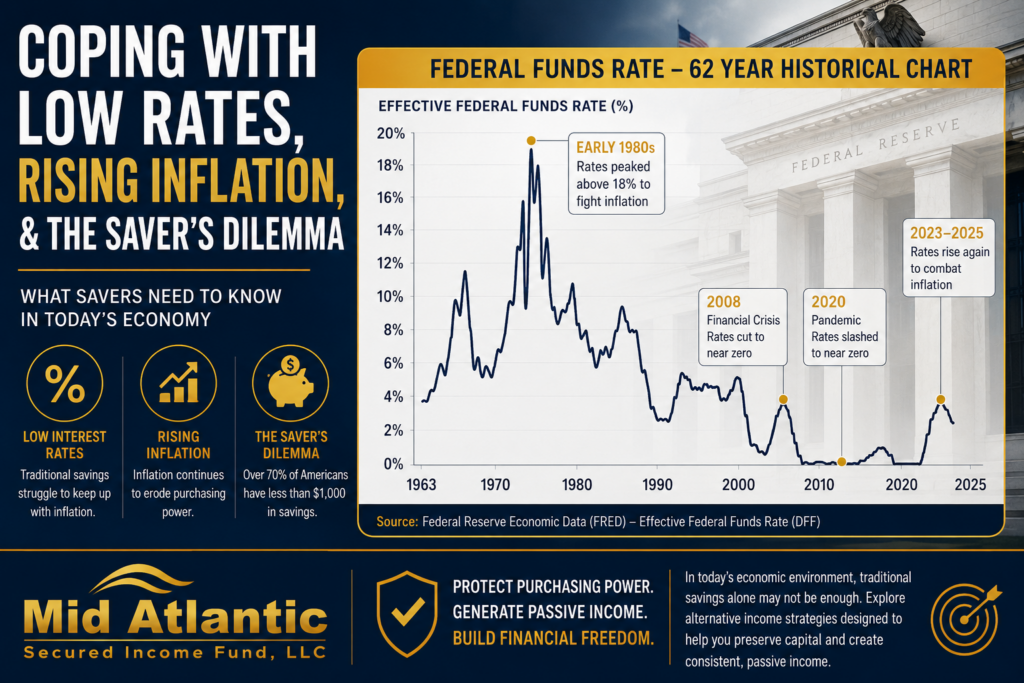
Federal Reserve rate policy, persistent inflation concerns, and periodic volatility across stocks and bonds have pushed many accredited investors to revisit alternative income strategies. Real estate-backed private credit has drawn attention because it can offer current income supported by contractual loan payments and tangible collateral rather than relying primarily on public market pricing.
That matters most for investors focused on predictability. In a secured lending model, the goal is not to outperform through speculation. It is to generate income through disciplined underwriting, conservative structures, and active management of borrower risk. Mid Atlantic Secured Income Fund operates within that philosophy, emphasizing first-position collateral, short-duration lending, and capital preservation alongside current income.
This approach will not fit every investor. Private investments are generally less liquid, available only to eligible investors, and dependent on manager execution. But for accredited investors seeking alternatives to low-yield traditional income products, the combination of high current income, lower volatility potential, and asset-backed structures can be compelling.
Where these investments may fit in an income portfolio
The most effective use of high yield passive income investments is usually not as an all-or-nothing allocation. They often serve as a complement to traditional fixed income, cash reserves, and other income-producing assets. For self-directed IRA investors, rollover IRA investors, and those evaluating unused 401(k) assets, private credit can be especially relevant when the objective is current income without direct property management responsibilities.
A prudent allocation depends on time horizon, liquidity needs, risk tolerance, and concentration limits. Investors nearing retirement may prioritize consistency and collateral quality over maximizing yield. Family offices and institutional allocators may place more weight on manager sourcing, servicing infrastructure, and portfolio-level diversification. Either way, the principle is the same: income should be evaluated through the lens of durability, not marketing.
The best passive income strategy is rarely the one with the most aggressive headline. It is the one you can understand, monitor, and hold with confidence when markets become less cooperative.