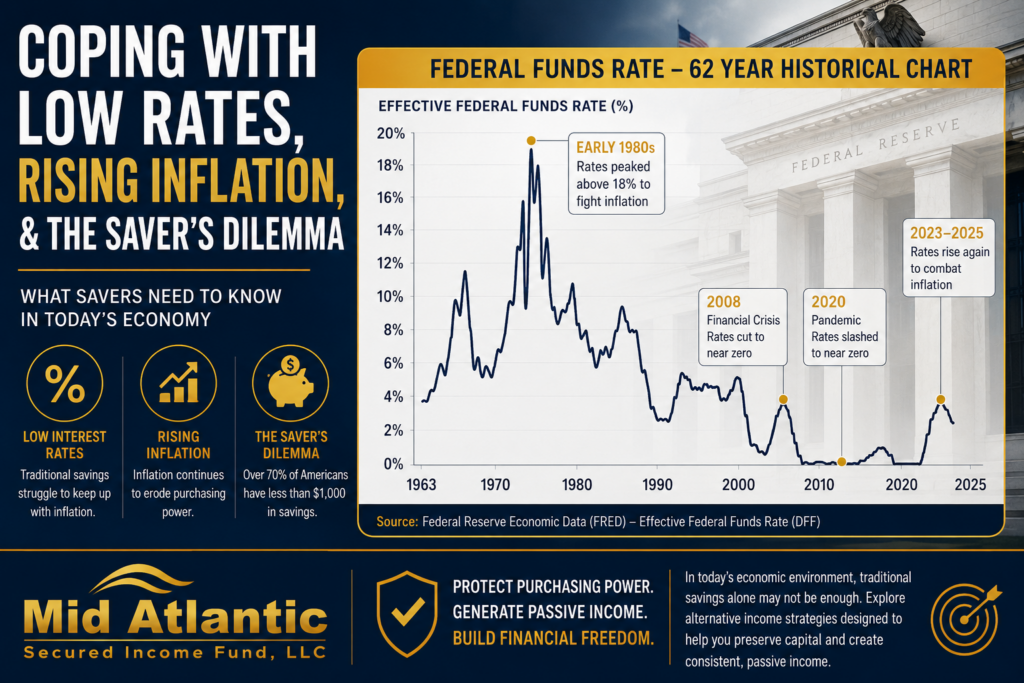

The economic outlook for investors is no longer defined by one question about whether rates will fall. It is defined by a more practical set of decisions: where income comes from, how much risk is being accepted to earn it, and whether the underlying assets can withstand slower growth, uneven property markets, and changing capital costs. For accredited investors focused on preservation and cash flow, the distinction matters.
Public markets can react sharply to economic releases and policy expectations. Private credit is not immune to economic conditions, but its return profile is driven more directly by loan structure, collateral quality, borrower performance, and underwriting discipline. That makes it a useful area of focus for investors who want to evaluate income opportunities on their actual protections rather than on market headlines alone.
What Is Shaping the Economic Outlook for Investors?
The central economic challenge is not necessarily a single recessionary event. It is the persistence of uncertainty. Inflation has moderated from its highest levels, yet the Federal Reserve remains focused on its mandate to restore and sustain price stability. Interest-rate policy, employment conditions, consumer spending, commercial real estate refinancing, and government financing needs can all influence markets at the same time.
For income investors, this environment creates both opportunity and pressure. Higher base rates have improved the income available from many fixed-income instruments. At the same time, higher borrowing costs can strain leveraged businesses, real estate projects, and property owners approaching loan maturity. A yield should therefore never be evaluated separately from the credit risk required to produce it.
The Federal Reserve’s policy statements, FDIC banking data, and Mortgage Bankers Association lending and delinquency research offer useful signals about credit conditions. But they do not replace deal-level analysis. Broad economic data can indicate where pressure may be building. Sound underwriting determines whether a particular loan has sufficient protection if that pressure reaches the borrower.
Rate cuts are not the only investment variable
Many portfolios have been positioned around the expectation that declining interest rates will support bond prices and reduce financing costs. That may occur over time, but the pace and scale of any policy changes remain uncertain. Investors should avoid constructing an income strategy that only works under one rate scenario.
A durable allocation considers what happens if rates remain elevated, decline gradually, or move lower because growth weakens. Short-duration private loans can be particularly relevant in this setting because capital is generally recycled over a shorter period than in long-dated fixed-income holdings. This does not eliminate risk, liquidity constraints, or reinvestment risk. It does, however, reduce the need to make a single long-term interest-rate forecast.
Credit selection matters more as financing costs stay high
Higher rates expose weak capital structures. Borrowers with limited equity, thin cash reserves, unrealistic project timelines, or an uncertain exit strategy have less room for error. In real estate lending, those conditions can turn an ordinary construction delay or sale-price adjustment into a credit event.
That is why conservative loan-to-value ratios, independent collateral assessment, borrower experience, and clearly documented repayment sources are not administrative details. They are the foundation of principal protection. CoreLogic and similar housing-market research can help investors understand regional pricing trends, but property-level underwriting must account for the asset, sponsor, local demand, construction budget, and expected loan duration.
Where Income Investors May Find More Control
Traditional bond allocations remain appropriate for many investors, particularly where liquidity and daily pricing are priorities. Yet public fixed income has trade-offs. Longer-duration bonds can be sensitive to rate movements, while lower-quality credit may be vulnerable if economic growth slows. Dividend-oriented equity strategies may provide income, but their values and distributions can still be affected by public-market volatility and corporate earnings.
Real estate-backed private credit occupies a different role. Rather than owning property and relying on appreciation, the lender provides capital secured by a first-position lien on real estate. The investor’s focus is on contractual interest income and repayment of principal, supported by the value of pledged collateral.
This distinction is important. Equity real estate investors typically depend on property operations, market appreciation, and a profitable sale or refinancing event. A senior secured lender has a defined claim on collateral and is generally paid before junior debt and equity if a borrower defaults. That priority does not guarantee repayment, and foreclosure can be lengthy and costly. Still, it can provide a materially different risk framework from an unsecured income investment or a speculative property position.
The value of short-duration, first-position lending
Short-term bridge, renovation, redevelopment, and construction loans serve borrowers with a specific business purpose and a defined anticipated exit. For the investor, a shorter duration can limit exposure to long periods of economic change. It also allows loan terms and underwriting assumptions to be reassessed as capital is redeployed.
The quality of that strategy depends on execution. A fund should be able to explain how it verifies collateral value, sets loan-to-value limits, evaluates the borrower, monitors construction or renovation progress, documents insurance, and manages loans when the original repayment timeline changes. A stated target return is less meaningful without those operating controls.
At Mid Atlantic Secured Income Fund, the underlying premise is straightforward: income should be supported by secured lending, conservative leverage, and disciplined due diligence rather than by reliance on real estate appreciation. For investors, that is a framework to evaluate, not a substitute for reviewing offering documents and conducting independent due diligence.
Risk Management Should Be Visible, Not Assumed
Private credit can offer attractive current income, but it is not a cash equivalent and it is not publicly traded. Accredited investors should consider it as part of a broader allocation after understanding the risks that are specific to private placements.
Liquidity is one of the most significant considerations. Private fund interests may have transfer restrictions, redemption limits, holding periods, and limited secondary-market options. Investors should avoid committing capital that may be needed for near-term expenses, tax obligations, or emergency reserves.
Concentration also deserves close attention. A portfolio with a large exposure to one borrower, project type, market, or repayment source may be more vulnerable than its headline yield suggests. Geographic diversification can help, but it does not compensate for poor underwriting. A well-structured loan in a familiar market may be preferable to a superficially diversified pool of weaker credits.
Investors should also ask how a manager treats extensions, defaults, and recoveries. Real estate collateral is valuable only if the lien is properly perfected, the valuation is realistic, insurance is maintained, and the manager has the expertise to protect the position when a loan does not perform as planned. The best time to understand a servicing process is before there is a problem.
A Practical Framework for Evaluating Private Income Opportunities
When reviewing a real estate-backed private credit offering, investors can concentrate on four connected questions:
- What secures the loan? Confirm lien position, collateral type, valuation approach, loan-to-value ratio, title protections, and insurance requirements.
- How will the borrower repay? Evaluate whether repayment depends on a credible property sale, refinance, project completion, operating cash flow, or another clearly defined source.
- Who is managing the credit? Review underwriting standards, servicing capabilities, experience through difficult market periods, and alignment between the manager and investors.
- What are the fund-level terms? Understand fees, distribution policy, liquidity provisions, concentration limits, tax reporting, and the risks described in the private placement memorandum.
These questions are particularly relevant for self-directed IRA and rollover IRA investors. Qualified retirement capital can potentially participate in private real estate credit through an appropriate self-directed account structure, subject to custodian requirements and applicable rules. Investors should recognize that retirement accounts do not remove the need for liquidity planning. Required distributions, account expenses, and investment timing should be considered before allocating long-term retirement assets to a private offering.
Building for Income Without Chasing Yield
The most constructive economic outlook for investors is not a prediction that every asset class will perform well. It is an acknowledgment that portfolio resilience comes from matching each allocation to a clear purpose. Liquid reserves serve one purpose. Public bonds may serve another. Private, asset-backed credit may provide a complementary source of current income for investors who can accept reduced liquidity in exchange for potentially differentiated exposure.
A higher distribution rate alone is not evidence of a better investment. It may reflect longer duration, weaker collateral, subordinate lien status, concentration, leverage, or limited borrower quality. The more useful question is whether the proposed income is commensurate with the structure and risks being accepted.
Economic conditions will continue to change. A disciplined investor does not need to predict every policy decision or market movement to act thoughtfully. They need a clear understanding of where their income is generated, what protects their capital, and whether the investment remains appropriate if the economic path differs from expectations.