
A portfolio can look strong on paper and still fail the real test: producing dependable income when markets turn volatile. That is why the question of real estate investing vs stocks is not really about which asset class wins in every cycle. It is about which risks you are willing to own, how much volatility you can tolerate, and whether your priority is long-term appreciation, current income, or capital preservation.
For accredited investors, this comparison becomes more nuanced. Public equities offer liquidity, broad market exposure, and decades of historical return data. Real estate can offer tangible collateral, income potential, and different return drivers than public markets. But direct property ownership, public REITs, and real estate-backed private credit do not behave the same way. Treating them as one category can lead to poor portfolio decisions.
Real estate investing vs stocks starts with the cash flow question
If your objective is wealth accumulation over a long time horizon, stocks have a compelling case. Public equities have historically rewarded patient investors through capital appreciation and reinvested dividends. They are easy to buy, easy to sell, and simple to scale inside taxable accounts and retirement accounts.
But if your objective is predictable income, the conversation changes. Many stocks pay dividends, yet dividend yields can fluctuate, boards can reduce payouts, and share prices can decline sharply even when the underlying business remains sound. Income from stocks is often secondary to growth.
Real estate, by contrast, is often evaluated first on cash flow. Rental properties can generate monthly income, and real estate-backed private credit strategies are typically built around contractual interest payments. That distinction matters for retirees, rollover IRA investors, and family offices that prioritize distributions over headline appreciation.
The source of that income also matters. Equity owners depend on business performance and market sentiment. In a collateralized private real estate lending strategy, income may come from borrower interest payments tied to loans secured by underlying real property. That can create a different risk profile than owning common stock, particularly when underwriting standards are conservative and loan-to-value ratios are disciplined.
Volatility looks very different in public markets and private real estate
One reason many investors revisit this debate after age 50 is volatility fatigue. Stock market drawdowns are visible in real time. Account values can move meaningfully in a single week based on earnings revisions, rate expectations, geopolitical events, or broad risk-off sentiment.
That daily pricing is both a strength and a weakness. Liquidity gives investors flexibility, but it also exposes them to the emotional pressure of constant mark-to-market movement. Many investors discover that they are comfortable with volatility only until they experience it during a period when they need liquidity or income.
Real estate investments do not all avoid volatility, but the way volatility shows up can be different. Direct property values tend to reprice more slowly than public stocks. Private real estate credit strategies are not typically quoted minute by minute on an exchange. That does not eliminate risk, but it can reduce the day-to-day price noise that drives reactive decision-making.
For investors focused on portfolio stability, the distinction between price volatility and credit risk is important. A stock can decline because market sentiment changed. A real estate-backed loan can face risk if the borrower underperforms, the project timeline extends, or collateral values weaken. The risk is real, but it is analyzed differently. It centers on underwriting quality, borrower strength, collateral coverage, and asset-level due diligence rather than quarterly market momentum.
Liquidity favors stocks, but liquidity is not the only measure of quality
Stocks are clearly superior on liquidity. Investors can generally enter and exit positions quickly, often at low transaction cost. That flexibility has value, especially for investors who need immediate access to capital or who actively rebalance portfolios.
Real estate is less liquid. Direct property ownership can take months to exit. Private funds may have hold periods, subscription structures, or limited redemption windows. For some investors, that is a drawback. For others, it is a useful constraint that aligns capital with longer-duration goals and reduces the temptation to make short-term decisions based on market headlines.
Liquidity should be matched to the role of the investment. If capital may be needed on short notice, public markets usually fit better. If the objective is passive income with less sensitivity to daily market swings, a lower-liquidity structure may be acceptable, provided the underlying assets and risk controls justify the trade-off.
Taxes, inflation, and portfolio role complicate the comparison
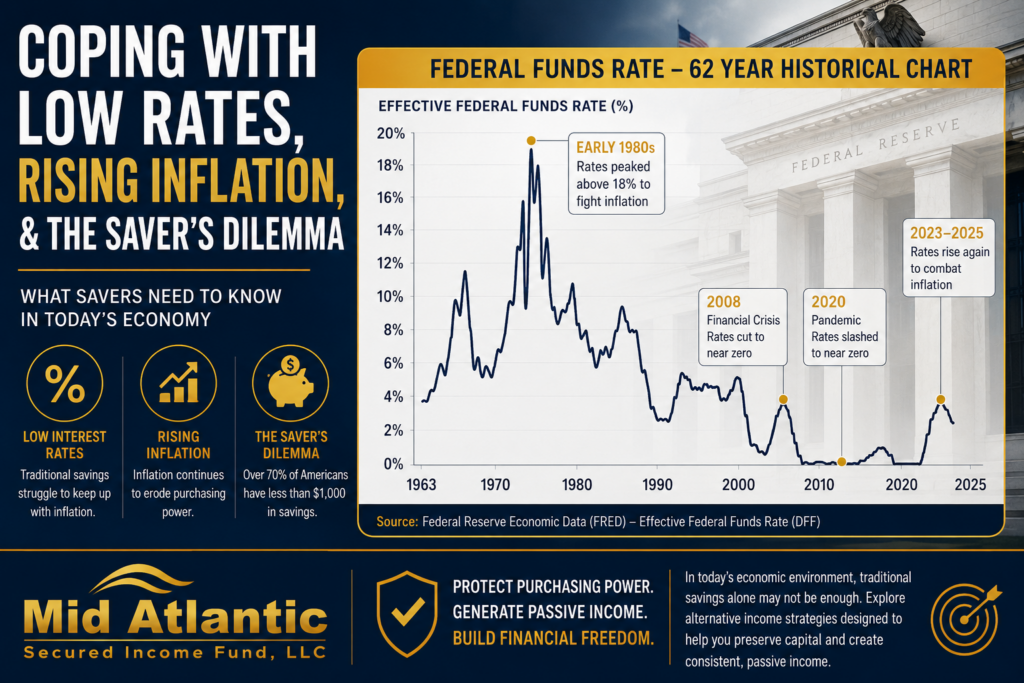
Real estate and stocks also behave differently under inflation and changing interest rate conditions. Companies in the stock market may or may not have pricing power. Some sectors manage inflation well, while others see margins compressed. Equity valuations can also come under pressure when rates rise.
Real estate often has a more direct relationship to hard assets and replacement costs. In some segments, rents and property values can adjust over time with inflation, though not uniformly and not without delay. In private real estate credit, shorter-duration loans may allow managers to reprice capital more frequently than traditional fixed-income securities, depending on the structure.
Tax treatment can differ as well, but that discussion depends heavily on account type and investor circumstances. Many accredited investors evaluating alternatives are doing so within self-directed IRAs, rollover IRAs, or other retirement structures where current taxable income may be handled differently than in a taxable brokerage account. That is one reason the portfolio role matters more than broad statements about which asset class is more tax efficient.
The biggest mistake in real estate investing vs stocks is treating real estate as one thing
This is where many comparisons break down. Owning a rental property is not the same as buying a public REIT. Buying a REIT is not the same as investing in a private equity real estate fund. And none of those are the same as investing in a real estate-backed private credit strategy focused on short-term first-position mortgage loans.
Direct ownership can offer control and tax advantages, but it also brings leasing risk, maintenance costs, financing risk, local market exposure, and operational burden. Public REITs offer convenience and liquidity, but because they trade on public exchanges, they can correlate more closely with broader equity market volatility than many investors expect.
Private real estate credit occupies a different part of the capital stack. Rather than owning the upside and downside of the property as an equity investor, the lender focuses on income generation and downside protection through collateral, structure, and underwriting discipline. For investors who value current income and capital preservation, that distinction can be more relevant than the broader real estate vs stock debate.
A disciplined lender is not relying on rapid property appreciation to make the investment work. The emphasis is on loan terms, borrower quality, exit strategy, and conservative collateral coverage. That approach will not capture the full upside of a booming property market, but it may offer a more controlled risk-return profile for investors who are less interested in speculation and more interested in dependable distributions.
Which investors may prefer stocks
Stocks may be the better fit for investors with long time horizons, high tolerance for market volatility, and a primary objective of capital appreciation. They also make sense for investors who value daily liquidity, broad diversification, and straightforward implementation through conventional retirement and brokerage accounts.
For accumulation-focused investors still many years from needing income, the ability to compound through equity market exposure remains powerful. That is especially true when the investor can tolerate drawdowns without being forced to sell.
Which investors may prefer real estate exposure
Real estate may be more attractive for investors who want tangible asset exposure, cash flow potential, and return drivers that are not identical to public equities. Within that category, private real estate credit can be especially relevant for accredited investors seeking high current income with a strong emphasis on collateral and risk management.
That tends to resonate with retirees, self-directed IRA investors, and those rolling over old 401(k) assets who are less concerned with maximizing upside and more focused on generating passive income without the operational demands of property ownership. It can also appeal to investors who want real estate exposure but prefer a senior secured position rather than equity-level risk.
At firms such as Mid Atlantic Secured Income Fund, that approach is built around short-duration lending, first-position mortgages, and conservative loan-to-value parameters designed to prioritize investor protection. The appeal is not excitement. It is structure.
A better question than which is better
Asking whether stocks are better than real estate is often too broad to produce a useful answer. A more disciplined question is this: what role should each asset play in your portfolio, and what risks are you being paid to take?
If you want liquidity and long-term growth, stocks may deserve a meaningful allocation. If you want income, lower correlation to daily market pricing, and asset-backed exposure, real estate may also deserve a place. For many accredited investors, the most effective approach is not choosing one and rejecting the other. It is distinguishing between speculative exposure and structured income, then allocating capital accordingly.
The strongest portfolios are usually not built around a headline preference for one asset class. They are built around clarity – what you need the capital to do, when you need it to do it, and how much uncertainty you are willing to accept along the way.