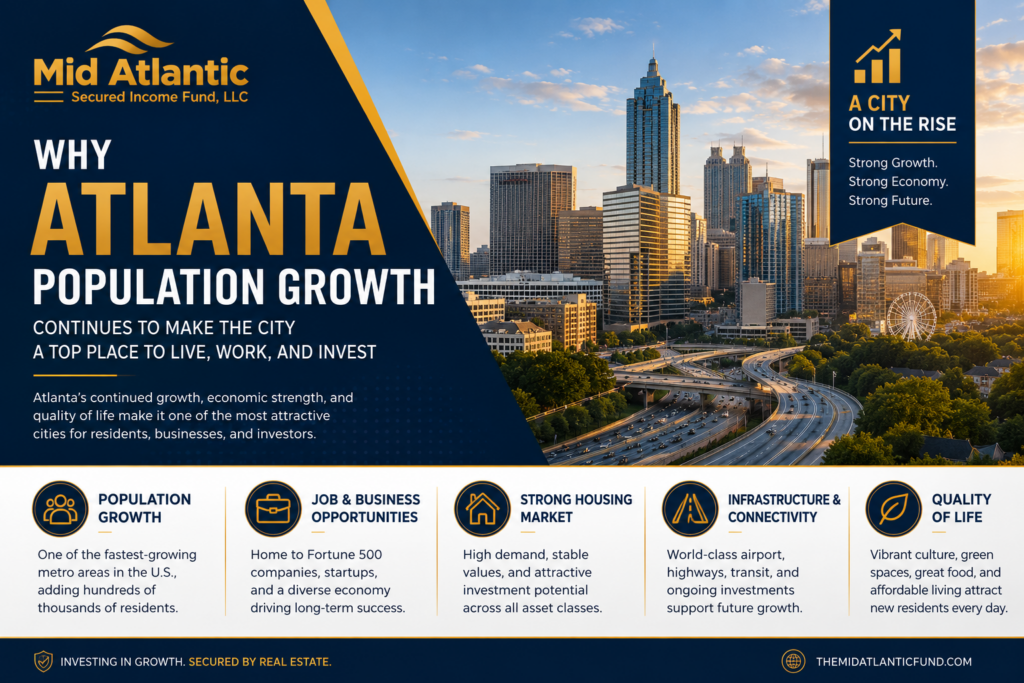

A metro does not add households at scale without changing the math for land, labor, housing, and credit. That is why atlanta population growth matters to more than homebuilders and city planners. For accredited investors evaluating real estate-backed private credit, it is a signal worth watching because population trends can influence borrower demand, development velocity, rental absorption, and the durability of underlying collateral.
Atlanta has spent years attracting new residents from higher-cost markets, expanding corporate footprints, and drawing younger workers as well as retirees seeking relative affordability. That broad demand base has helped support residential construction, redevelopment, logistics, mixed-use projects, and infill activity across the metro. But population growth by itself is never an investment thesis. The more useful question is whether that growth converts into disciplined lending opportunities with enough collateral protection to withstand shifts in rates, costs, and local supply.
Why atlanta population growth matters to lenders
Population growth tends to show up in real estate credit before it shows up in long-term appreciation narratives. More residents typically mean more demand for housing, neighborhood services, warehousing, road improvements, and adaptive reuse. That can create financing needs for builders, operators, and investors who need bridge capital, construction financing, or short-duration loans tied to clear business plans.
For a credit-focused investor, the appeal is not simply that a market is growing. It is that growth can support borrower exit paths. A new construction loan is stronger when there is measurable demand for finished units. A renovation loan benefits when the surrounding submarket is seeing household formation and improving absorption. A bridge loan becomes more understandable when the asset sits in a metro with diversified employment, ongoing in-migration, and multiple buyer or refinance options.
That said, growth can also invite excess. Fast-growing metros often see land prices rise, contractor availability tighten, and project budgets drift upward. In those conditions, underwriting discipline matters more than market enthusiasm. A lender that relies on conservative loan-to-value ratios, local market diligence, and realistic timelines is positioned differently than one underwriting to best-case assumptions.
The drivers behind Atlanta population growth
Atlanta’s growth story is not built on one industry or one buyer type. That matters. Markets supported by a single employer or narrow economic base can reverse quickly. Atlanta has historically benefited from a broader mix of transportation, healthcare, professional services, technology, education, logistics, and film-related activity. The metro also functions as a regional business hub for the Southeast, which has helped support office users, industrial demand, and residential migration over time.
Relative affordability has been another factor, although that advantage has narrowed in some submarkets. Compared with several coastal metros, Atlanta has offered more attainable home prices, larger housing stock, and lower occupancy costs for many businesses. Even when mortgage rates rise, migration can persist if households are still finding better value than in origin markets.
Infrastructure and geographic scale also play a role. Atlanta is not a small, land-constrained city with one core growth node. It is a large and evolving metro with multiple suburban and exurban pockets, each responding differently to demand. Some corridors support new single-family development. Others favor townhomes, multifamily, industrial, or redevelopment. For lenders, that means atlanta population growth should be analyzed at the submarket level rather than treated as one uniform trend.
What population growth means for housing supply
The direct effect of a growing population is pressure on housing inventory. If household formation outpaces completions, vacancy tightens and prices or rents tend to adjust. That can create opportunity, but it also raises execution risk. Developers may move faster, compete harder for labor, and underwrite more aggressively in order to meet perceived demand.
This is where private credit can serve a practical role. Short-term, real estate-backed lending can help finance infill construction, renovation, redevelopment, and transitional assets that conventional lenders may approach more slowly. In a market like Atlanta, speed and structure matter because demand can shift while a borrower is waiting on financing.
Still, lenders should separate durable demand from temporary imbalances. A neighborhood experiencing a burst of investor activity is not automatically a sound lending environment. The stronger indicator is whether local income growth, employment, transportation access, and absorption trends support the product being financed. Population growth helps, but project viability depends on who is moving in, what they can afford, and how much new supply is already underway.
Residential segments are not moving in lockstep
Single-family, build-to-rent, multifamily, and condo product types can respond very differently to the same macro trend. Higher rates may slow for-sale absorption while rental demand stays resilient. Luxury multifamily may face more competition than workforce-oriented product. Outer-ring suburban development can perform well in one cycle and lose momentum in another if commuting costs rise or infrastructure lags.
That is why disciplined lenders focus on collateral quality, sponsor experience, basis, and borrower exit strategy rather than relying on broad metro headlines. Population growth can support the backdrop, but loan performance usually turns on local execution.
The investor lens: growth is useful, but collateral matters more
For accredited investors seeking passive income, Atlanta can be an attractive market to watch because it generates a recurring need for capital tied to real assets. Yet the investment case in private credit is not based on betting that property values will keep rising. It is based on whether loans are secured by assets with defensible value, whether underwriting leaves room for error, and whether income is produced through structured lending rather than speculative ownership.
This distinction is important in periods of economic uncertainty. Population growth may remain positive even while cap rates reset, construction costs stay elevated, or bank lending standards tighten. In those moments, senior-secured private credit can offer a different risk profile than direct equity exposure because the lender sits higher in the capital stack and can prioritize principal protection through collateral, legal position, and loan structure.
Investors evaluating exposure to markets influenced by atlanta population growth should ask practical questions. What loan-to-value standards are being used? How is borrower experience verified? Are draws tied to progress? What assumptions support the exit? How diversified is the underlying loan book by asset type and geography? Those questions matter more than broad claims about a city’s momentum.
Risks beneath the headline numbers
Strong migration does not eliminate credit risk. In some cases, it can conceal it. Borrowers may overestimate resale prices, underestimate stabilization periods, or assume rents will absorb at levels the market cannot sustain. Construction delays can erode interest reserves and contingency budgets. Local policy shifts, zoning constraints, or utility timelines can also affect project economics.
Atlanta is no exception. Some submarkets may become oversupplied faster than others. Certain asset classes can cool even while population continues to rise. A lender that underwrites to disciplined downside scenarios is better positioned than one relying on metro growth as a substitute for analysis.
Federal Reserve policy and regional banking conditions also influence the lending environment. When banks tighten, private lenders may see more opportunities, but not every opportunity is attractive. Better deal flow can improve selectivity, yet weaker borrowers may also seek capital when conventional sources pull back. The advantage belongs to managers willing to say no often and structure loans around protection first.
Why discipline matters more in growing metros
Fast-growing markets can produce a false sense of safety because rising demand makes weak underwriting less visible for a time. Projects refinance, units lease, and values increase enough to cover mistakes. But once rates move, supply catches up, or timelines extend, weak structures are exposed. Conservative leverage and first-position security become much more valuable in that phase of the cycle.
That is the core reason many income-oriented investors prefer real estate-backed private debt over direct speculation in high-growth markets. If the strategy is built around current income, collateral, and short-duration loans, the investor does not need every property to appreciate sharply. The objective is steadier cash flow supported by disciplined credit selection.
A measured way to interpret Atlanta’s growth
Atlanta remains one of the more consequential metros in the Southeast for housing demand, commercial activity, and development financing. Its scale, business base, and migration profile continue to create lending demand across residential and commercial real estate. That makes it relevant for investors studying where private credit opportunities may emerge.
But the right takeaway is not that growth guarantees attractive outcomes. It is that a growing metro can provide a stronger operating backdrop for carefully underwritten loans than a stagnant one, provided the lender maintains discipline on leverage, collateral, and borrower quality. For firms such as Mid Atlantic Secured Income Fund, that distinction is central. Market growth may create opportunity, but risk management is what turns opportunity into durable income.
If you are evaluating income-oriented alternatives, Atlanta is worth watching not because the headline is exciting, but because population trends can help reveal where real estate credit demand is likely to remain active. The better question is never whether a market is growing. It is whether the loans made into that market are structured to protect capital if growth cools.