
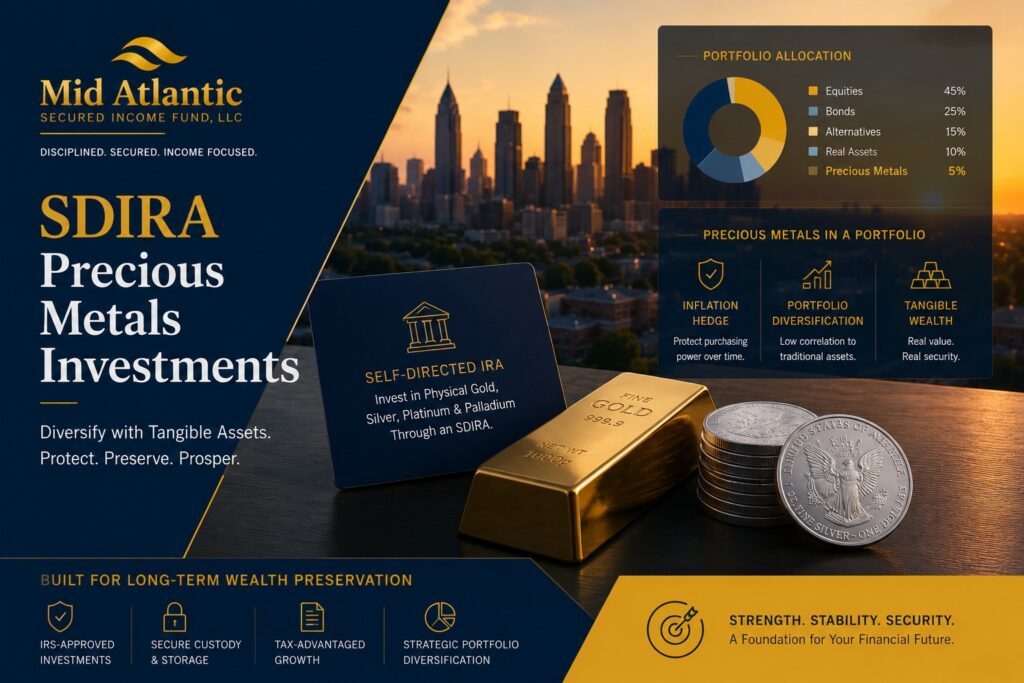
SDIRA Precious Metals Investments
Why Gold, Silver & Alternative Hard Assets Continue to Attract Retirement Investors For decades, retirement portfolios in the United States have largely revolved around traditional equities, bonds, and mutual funds. Yet macroeconomic instability, inflation volatility, elevated government debt levels, geopolitical fragmentation, and changing monetary policy regimes are reshaping how investors think about long-term wealth preservation. Increasingly, sophisticated investors are exploring alternative assets inside tax-advantaged retirement structures — particularly Self-Directed IRAs (SDIRAs). Among the most recognized alternative retirement assets are precious metals investments, including physical gold, silver, platinum, and palladium held through IRS-compliant custodial arrangements. While precious metals do not generate cash flow in the same way dividend-paying equities, real estate debt funds, or private credit investments can, many investors view them as strategic portfolio stabilizers designed to hedge against inflation, currency debasement, systemic risk, and market uncertainty. For accredited investors and retirement-focused allocators, SDIRA precious metals investments are often not about speculation. Instead, they are frequently used as a component of broader portfolio diversification and long-term capital preservation strategies. What Are SDIRA Precious Metals Investments? Direct Answer SDIRA precious metals investments involve holding IRS-approved physical gold, silver, platinum, or palladium within a Self-Directed IRA through an approved custodian and qualified depository. Unlike traditional brokerage IRAs that typically limit investors to stocks, ETFs, mutual funds, and bonds, a Self-Directed IRA allows investors to access a broader universe of alternative assets, including: Precious metals Real estate Private credit Private equity Tax liens Limited partnerships Secured debt investments The IRS imposes specific requirements regarding: metal purity, eligible products, approved custodians, and storage procedures. Investors cannot personally store IRA-owned precious metals at home without risking prohibited transaction violations. Why Investors Are Reconsidering Traditional Retirement Allocations The traditional 60/40 portfolio model has faced increasing scrutiny in recent years. Historically, investors relied on diversification between equities and fixed income. However, rising inflation and changing interest rate environments exposed weaknesses in portfolios heavily concentrated in publicly traded assets. According to Federal Reserve data, U.S. household net worth remains highly concentrated in equities and retirement accounts tied to public markets. Meanwhile, inflation-adjusted purchasing power concerns continue to drive interest in alternative stores of value. Several macroeconomic trends have accelerated interest in alternative retirement investments: 1. Persistent Inflation Concerns Following the post-pandemic inflation surge, investors became increasingly aware of inflation’s long-term impact on retirement purchasing power. Even moderate inflation can materially reduce future retirement income capacity over decades. According to Bureau of Labor Statistics data, cumulative inflation since 2020 materially increased costs across: housing, healthcare, insurance, utilities, food, and retirement living expenses. Many investors use precious metals as part of an inflation-hedging framework. 2. Elevated Market Volatility Public markets have experienced higher volatility amid: interest rate uncertainty, geopolitical tensions, banking sector instability, and global economic deceleration. Alternative assets often provide diversification benefits because they may behave differently than publicly traded securities. 3. Growing Interest in Hard Assets Institutional investors increasingly allocate capital toward real assets and alternatives. According to Preqin and BlackRock alternative investment research, institutional allocations to private markets and alternative assets have grown substantially over the past decade. This includes increased exposure to: infrastructure, real estate, private credit, commodities, and precious metals. How Precious Metals Work Inside an SDIRA The Basic Structure A Self-Directed IRA precious metals investment generally involves four components: Component Role Investor Owns the retirement account SDIRA Custodian Administers the IRA Precious Metals Dealer Facilitates asset acquisition Approved Depository Stores the metals The investor directs the investment decisions while the custodian handles reporting and compliance administration. IRS Rules for Precious Metals IRAs Not all metals qualify for IRA ownership. The IRS establishes specific standards under Internal Revenue Code Section 408(m). Eligible Precious Metals Generally Include: Gold Minimum purity: 99.5% Silver Minimum purity: 99.9% Platinum Minimum purity: 99.95% Palladium Minimum purity: 99.95% Examples of commonly eligible products may include: American Gold Eagles Canadian Maple Leafs Gold bars from approved refiners Silver bullion products Certain platinum and palladium coins Collectible coins are generally prohibited. Can You Store IRA Gold at Home? Direct Answer Generally, no. IRS rules require IRA-owned precious metals to be held by an approved trustee or qualified depository. Improper storage arrangements may create: prohibited transactions, early distribution events, penalties, and tax consequences. This is one reason experienced custodians and compliance-focused administrators are critical in SDIRA investing. Why Investors Use Precious Metals in Retirement Portfolios 1. Inflation Hedging Gold has historically been viewed as a long-term hedge against currency debasement and inflationary pressure. Although gold prices can fluctuate significantly over shorter periods, many investors view precious metals as a purchasing power preservation asset over long time horizons. 2. Portfolio Diversification Precious metals may exhibit lower correlation to traditional equities during periods of market stress. Diversification is one of the primary reasons institutional investors include alternative assets in portfolio construction. A diversified retirement allocation may include exposure across: equities, fixed income, real estate, private credit, infrastructure, commodities, and precious metals. 3. Geopolitical Risk Mitigation Periods of geopolitical instability often increase demand for perceived safe-haven assets. Precious metals have historically attracted investor attention during: banking crises, sovereign debt concerns, inflation shocks, military conflicts, and currency instability. 4. Long-Term Wealth Preservation For some investors, precious metals are less about maximizing returns and more about preserving purchasing power over multi-decade retirement horizons. This is particularly relevant for: retirees, family offices, conservative allocators, and multi-generational wealth planning strategies. Are Precious Metals Better Than Stocks? Direct Answer Precious metals and stocks serve different portfolio functions. Asset Type Primary Purpose Stocks Long-term growth Bonds Income and stability Precious Metals Diversification and inflation hedging Private Credit Income generation Real Estate Cash flow and appreciation Most sophisticated portfolios use multiple asset classes rather than relying exclusively on one. Precious metals typically complement diversified retirement strategies rather than replace growth-oriented assets entirely. Gold vs Silver in Retirement Accounts Gold Gold is generally viewed as: a monetary hedge, wealth preservation asset, and institutional reserve asset. Central banks globally continue holding substantial gold reserves. Silver Silver often carries both: industrial demand exposure, and monetary characteristics.
SDIRA Precious Metals Investments Read More »